



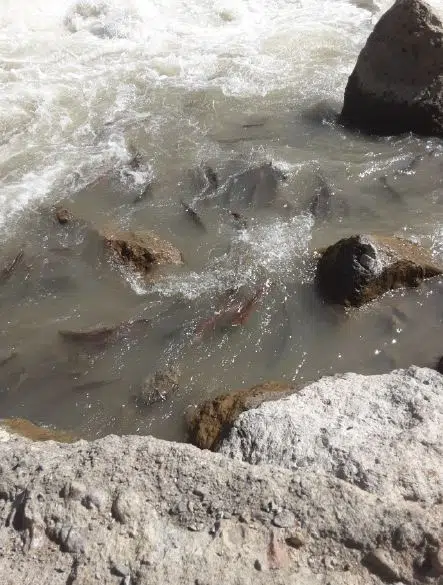
Officials at the Big Bar rock slide say over 30,000 fish swam past the site on September 1 using a natural fish passage.
It’s the most number of fish to have passed through the area in a single day, more than double the 14,000 that passed through on August 31st.
The Department of Fisheries and Oceans Environmental Lead Michael Crowe says the priority is still to establish channels to allow fish to swim through the site on their own.
“The work area has increased in size due to water levels continuing to drop,” he said. “However, it remains a challenging work site. As many of you know, it’s at the base of a 125 metre cliff. Temperatures fluctuate significantly as well they are working immediately and in a raging waterfall, being the Fraser River.”
During a technical briefing, he said about 73,000 fish have been able to swim past the site on their own; largely thanks to work done by rock scaling crews.
“They have moved countless boulders, many the size of vehicles. Combined with water levels dropping, this has made a significant difference in the salmon’s ability to swim past the slide,” Crowe added.
“Before we even had those numbers from our monitoring system, scalers had observed a substantial increase in the fishes’ ability to get past them at the worksite.”
Crowe adds to date about 60,000 salmon – mostly sockeye – have also been transported past the slide site by helicopter.
He says chinook numbers have dropped steadily, but there is still a large number of sockeye and an increasing number of pink salmon beginning to gather at the site.
“We are expecting pink salmon to arrive in very large numbers in the coming days. It could be as many as 1.5 million fish,” he said. “Pink salmon however are smaller and weaker swimmers than the chinook and sockeye, which have been able to get past the slide. So at this time, we are uncertain if the recent success with sockeye will also be achieved with the pink salmon.”
There are also plans underway to get a so-called ‘spider excavator’ to the base of the slide to go around difficult terrain allowing for rocks to be blasted and removed.
Crowe added that officials are also working to deal with challenges in the area where a new road has been built to transport fish by road at night when helicopters can’t fly.