




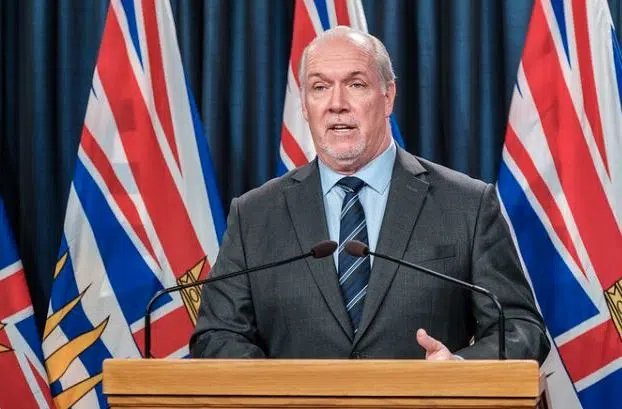
The Premier says the responsibility for dealing with the Tiny House Warriors protest camp near Blue River falls on the RCMP as well as the Simpcw First Nation as well as Tk’emlúps te Secwépemc.
Asked about the issue as the Tiny House Warriors continue to protest the Trans Mountain pipeline expansion, John Horgan says if there are laws being broken, the police should address it.
“If the chief and other community members feel that their liberty is being impinged by other people, they should call the cops,” he said, during a press conference earlier this month.
“I cannot tell the cops what to do, but if citizens who are there charged with protecting [the area] have concerns, they should raise that with local law enforcement and law enforcement in my opinion should respond to that.”
He noted it is up to the title holders on the land to make determinations about what can and cannot take place.
“Particularly if it is a demonstration that is highlighting Indigenous rights and title,” Horgan said. “Obviously, I defer to the chiefs to make determinations on her lands.”
The chiefs of both the Simpcw First Nation as well as Tk’emlúps te Secwépemc noted they gave their free, prior, and informed consent to the pipeline in 2017. They are also calling on the Tiny House Warriors to take down their protest camp.
“I share their concern for the safety of women and girls, but they won’t talk to us about the work we’re doing… For example, we currently have 19 women working at Trans Mountain. They report positive experience, and no serious incidents,” Simpcw Chief Shelly Loring said.
Following a meeting last week, the Thompson Nicola Regional District will be asking the Premier to intervene after Blue River area residents came out in force to a public meeting last month, to express concern about the protesters.
“I just want to see this defused and solved before it goes into further violence. And in my opinion it does have that possibility. This affects our community, it affects the region, it affects the First Nations in our area,” Area Director Stephen Quinn noted.
Horgan noted that he would be happy to speak to the chiefs about their concerns, saying that the apparent inability or unwillingness for police to act was why a review of the police act is needed.
“I appreciate their frustration,” Horgan said. “Law enforcement doesn’t know, from day to day, I think, where their responsibility begins and ends. And this is a challenge and why it is so important that we do a review of the police act, as we’re undertaking right now.”