




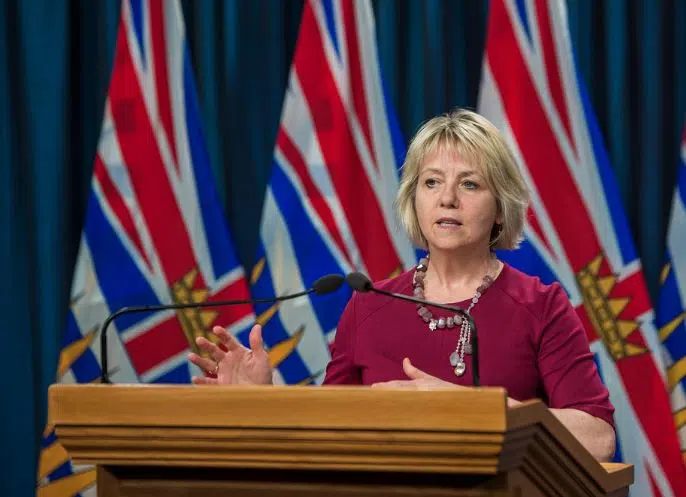
Dr. Bonnie Henry during a COVID-19 update briefing. (Photo via BC Government)
The province’s top doctor believes the COVID-19 reproductive number (R-number) – that’s the number of people one case will transmit the virus to – can be brought below one without the need to close things up like we saw in March
Dr. Bonnie Henry says one way to bring things under control is to ensure people are having ‘safe contacts’ with each other.
“We know now that we are travelling more, we’re going to work, we’re going to different settings, so we are having contacts with more people,” she said, noting the spike in cases is not unexpected.
“What we need to do is to have those as safe contacts, which means keeping our distance, making sure that we have our numbers small, and if people do get sick, making sure we can find them quickly.”
Henry says new modelling has shown that B.C. risks the possibility of having explosive growth in our COVID-19 outbreak if people are not careful. She says if you contract COVID-19, there’s nothing that can be done to stop you from getting sick.
“However, what we can do is prevent you from spreading it to the next generation or the people that you are close to. So during that incubation period, keeping you away from others so that if you do become ill, you won’t spread it to anybody else,” Henry said. “And that is how we get that reproductive number down again.”
“This is all connected to our ability to do contact tracing. There are hundreds of people who have been exposed over the last few weeks, and we are connecting with them. And we need your help to continue to do that.”
Henry did say previously that a daily increase of 25 cases or more is ‘above her comfort zone’, calling the recent spike a warning for people to keep things in balance.
Given the high number of COVID-19 cases in recent days in the province, Health Minister Adrian Dix noted there could be ‘adjustments’ made this week to health orders.
He says some adjustments are clearly needed especially in the Kelowna area after an outbreak there earlier this month.
“Working with the business community, working with the municipality in Kelowna, Mayor [Colin] Basran, working with the opposition MLA Norm Letnick, we’re all working together to communicate better,” he said.
“So we have there for example in delivering our message, a lot of social influencers who have been involved in putting out messages in the last few days.”
Dix adds we also need to double down in what we’ve been doing, and that includes washing our hands and physical distancing.
“We just have to I think recommit ourselves fundamentally to what we have learnt, which has worked. And we’ve seen it work. We produced a serology report through the BC CDC that showed how we flattened the curve, and people could see in that data their efforts, and so we have to continue to do that.”
“I think we are going to have to adjust, and adjust, and adjust throughout this pandemic, which I remind everybody is not going away. There is no cure and there is no vaccine. So we have to continue to make adjustments.”
Kamloops mayor urging people to comply with public health orders
Here in Kamloops, the reiterates the word from health officials to be mindful of our interactions during phase 3 of the provincial reopening plan.
“The public has to be prepared: if the phone call comes and you’ve been exposed, can you tell us who you’ve been in contact with, and where you have been in the past 10 to 14 days? If you can’t recall that, then you’ve probably seen too many people and been to too many places,” Christian noted.
“So that while we’re going to open the economy here, and I think businesses are really clamoring for that, we need to be very purposeful and very mindful and very cautious about the way that we do that. Myself and council really want to see things get back to normal as fast as everyone else.”
B.C. health officials have indicated that people who tested positive in recent days had a large number of contacts, somewhere in the range of 11-to-12 people on average.
– With files from Colton Davies