



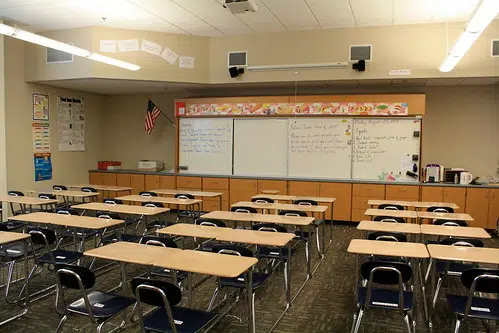
Education Minister Rob Fleming says Kindergarten to Grade 7 students in B.C. will return to class full time on September 8, while kids in Grade 8 to 12 will be in school at least two days per week.
Outside of the classroom, elementary students will be limited to cohorts of 60 students, called learning groups, and that limit is 120 for high school students.
“Learning groups are smallest in elementary and middle schools because it is more challenging for younger students to maintain physical distance. Older students are better able to minimize physical contact, practice hand hygiene and recognize if they are experiencing symptoms of COVID-19,” said a statement from the province.
Education Minister Rob Fleming noted these students learning in a group is different from students in a class.
“They will be able to interact and connect with each other as a group during breaks, in common areas like the gym or in the library, at playgrounds or on school buses,” he noted.
“Limiting the number of people each student or staff member comes into contact with will reduce the risk of transmission and will ensure better contract tracing from health authorities.”
Fleming says the province knows there is no substitute for in-class learning.
“And I heard that time and time again from parents, that students and teachers, when they had the chance to reconnect in June, that those in-person connections meant a great deal to students, families and teachers. There’s so many young people who need, and benefit, from a school setting.”
Provincial Health Officer, Dr. Bonnie Henry said she has ‘great confidence’ in the plan, and believes schools can safely reopen, as long as community transmission remains low.
“We cannot predict the future. We are planning for a number of scenarios — if there is increase in cases, [we] will review,” she said, adding there is no “magic number” of cases that would cause provincial officials to re-assess their plan.
Henry previously noted that masks would not be mandatory for kids when they return to school. She also noted it is important for families and workplaces to be flexible.
“We all need to understand that we’ve not been through this before, so we need to learn together and we need to plan for all contingencies,” Henry said.
“As I said many times, when this virus is anywhere, we’re at risk, but I do think that there is absolutely ways that we can get almost all children back into an in-class learning situation in the fall.”
The government is spending $45.6 million to increase custodial staff and cleaning in schools.
It includes more than $1-million across the Kamloops-Thompson School District, which will hire 17 more daytime custodial staff, install touch-less water fountains as well as other improvements to prevent COVID-19.
SD73 Superintendent Alison Sidow told NL News the district is ironing out how to manage in-class learning for its largest high schools like Valleyview, NorKam and South Kam secondary.
Plan is a work in progress says BCTF President
The President of the BC Teacher’s Federation says the return to school plan is a work in progress – with a lot of room for improvement.
Teri Mooring says her fellow teachers have many questions about how the plan will be implemented, noting the announcement left out several key components, like proper ways to physical distance in a classroom of 30 students.
“Even if older students as the doctor said are able to physically distance and understand the concept a lot better they’re still not able to do that in a classroom setting,” she said. “And so that means we’re going to have to reduce the number of students in classrooms.”
Mooring says the BCTF should be involved in the plan as it is able to give meaningful consultation.
“We have a lot of questions, and we have a lot of expertise and knowledge that needs to be taken into account, and it needs to help form the basis of the plan,” she added, admitting that she is glad the plan will be fine tuned through the rest of the summer.