




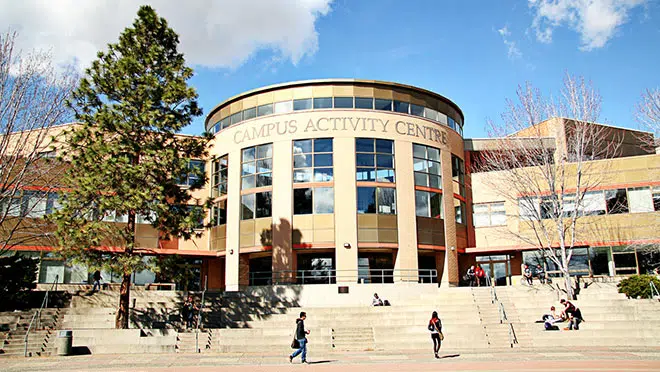
Campus Activity Centre at Thompson Rivers University/via TRU
After months of expecting a deficit as high as $9-million because of COVID-19, Thompson Rivers University expects to finish the 2020-2021 fiscal year with a surplus of about $3-million.
TRU President Brett Fairbairn says while revenue dropped because of the pandemic, so too did expenses.
“Next year is an open question because you know its not just whether we get a normal influx of first year students, we also have those students who are kind of missing in our system from last year,” he said, on NL Newsday. “So next year will perhaps be as difficult financially as this year but we made it through this year.”
Heading into the soon to be complete fiscal year, TRU was projecting a surplus around $8.4-million before the pandemic hit and the surplus turned to a deficit. TRU though was able to finish in the black because of higher than expected international student enrolment, despite there being travel restrictions in place.
“Our revenue went down because our finances are driven by student numbers but we’re managing through that and we certainly foresee being able to keep managing through it,” Fairbairn said. “Some of our expenses went up, some of them went down, but enough that we’re remaining in the black.”
Looking ahead to next year, the TRU board has approved a $238-million budget, which is forecasting a small surplus of $147,000.
Earlier this month, the province announced students at Thompson Rivers University and at other universities across B.C. are expected to be back to on-campus learning this fall. Fairbairn told NL News then that he’s excited but also a little nervous after a year filled with online classes.
“We have a year’s experience that gives a bit more predictability but there’s still lots of uncertainties left. How exactly the virus behaves, how the vaccine rolls out, what happens in terms of international travel affects us,” Fairbairn said.
International students account for about $60 million of revenue for TRU, while domestic student tuition is expected to bring in about $41.5 million. Other revenue is set to come from provincial grants (about $88 million), student fees ($12 million), as well as interest, sales, and other revenue ($26 million).
Built into the 2021-22 budget is a $5-million return-to-campus fund and a $3.8-million contingency fund to be split among the executive portfolios that will be released upon achieving second quarter enrolment and financial results.
“In the event TRU’s enrolments fall short of its planning, these contingencies can be used to cover any shortfalls. In addition, the Ministry of Advanced Education has permitted TRU to run a $5-million deficit which provides TRU financial flexibility in the event the budget assumptions turn out to be incorrect,” TRU provost Christine Bovis-Cnossen told the board.
Bovis-Cnossen and Matt Milovick, TRU’s Vice-President of Administration and Finance, say there are several risks associated with the 2021-22 budget but add they feel they’ll be able to mitigate the impacts if and when it arises.
“If the pandemic takes a turn for the worse (e.g. vaccinations become ineffective against new variants), TRU could find itself in a remote learning environment once again,” their report said. “While optimism is high at this time that vaccinations will deploy as scheduled and remain effective, if students are unable to return to campus, there is a real risk to enrolment as well as ancillary revenues.”
Another big risk is international student enrolment, with a target of 3,300 such students at TRU this year. As it stands, students are able to study in their home countries until December 2021 and still be eligible for a post-graduate work permit in Canada. The concern is that some international students may choose to continue studying from abroad, while others may be impacted by the quarantine requirements before they can enter Canada.
“Administration’s current estimate is that this could impact approximately 300 to 650 students. While administration is less concerned about a decline in international enrolment overall, students studying from abroad will increase teaching costs and potentially lower ancillary revenues with lower numbers of students physically coming to campus.”
India remains the top number-one source of international students studying at TRU, followed by China, Bangladesh, Nigeria, and Vietnam.