




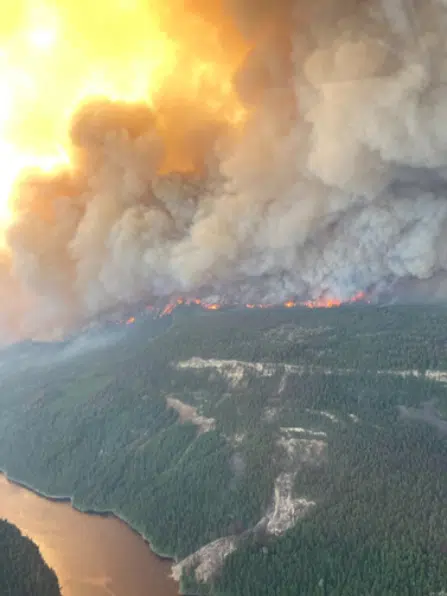
The Sparks Lake wildfire northwest of Kamloops on June 30, 2021. (Photo via BC Wildfire Service)
The Thompson-Nicola Regional District issued five-times more evacuation orders this summer because of wildfires compared to 2017.
There were 100 evacuation orders this year compared to 20 in the record 2017 fire season. This year there were also 193 evacuation alerts, many of which turned into orders at some point.
After weeks of smoke and extreme fire activity, TNRD emergency program coordinator Kevin Skrepnek warned in mid-August about a weather system coming that was more volatile than “many of us have ever seen.”
“We had a pretty dramatic weather event. A cold front moved through the province and the wind from that system really blew up a few of those fires. So we had an incredibly, incredibly 48 to 72 hours,” Skrepnek says.
“Thankfully, on the heels of that system, obviously things did get a little cooler. Temperatures went down, a little bit of rain in some areas. But had that weather pattern held on for another day or so, I suspect we would’ve seen significant additional losses.”
The TNRD has tallied 164 structure losses from wildfires within its boundaries, including 53 primary homes, 29 seasonal homes, seven commercial buildings, 67 accessory buildings and eight that have not been determined.
The emergency operations centre at the TNRD was open for 75 days, from late June to early September, and the EOC has cost close to $5.3 million. The cost of the EOC is more than double what it was in 2017, at close to $2.6 million.
Skrepnek says emergency operation costs are reimbursed by Emergency Management BC, although he says in the interim the cost puts a strain on reserve funds for the regional district. He says emergency operation costs are still being accumulated to support evacuees.
“There’s still well over 100 families right now without a home. The vast majority of those from Lytton, Lytton First Nation and the surrounding area, and of course a number of communities throughout the TNRD. Monte Lake, a number of houses along the Highway 8 corridor, Deadman-Vidette Road, etcetera.”
Despite costs being double for the EOC this year compared to 2017, there were 55 regional district staff working in the centre this year compared to 65 in 2017. Skrepnek pointed out he didn’t work for the TNRD yet in 2017, but he suspects there were efficiencies this year with how to staff the EOC.
Skrepnek says 2021 was a more challenging year than past record fire seasons, in 2017 and 2018, when he worked as the head of communications for the BC Wildfire Service. He says wildfire activity kicked off early this year with many significant fires starting in late June and July.
“Other than a complex of fires in the North Thompson, really it was mainly the Elephant Hill fire in 2017. That was a big, consequential and very aggressive fire that burned throughout the summer. The difference being in 2021, we had a half-dozen Elephant Hills burning at the same time, pretty much from one corner of the regional district to the other.”
Skrepnek says a full debrief of the fire season among TNRD staff will take place later this month and a report will follow and recommendations to come.