




Plans to build a film studio in the Kamloops area took another step forward with the release of conceptual plans for a $32.6-million facility on a five-acre plot of land.
Chad Rickaby, a manager with Nordicity – the firm which conducted the study – told the Thompson Nicola Regional District board there has been an increased demand for studio space around the world as movie producers respond to a demand from consumers for content, given the rise in popularity of streaming services.
The plans put forward by his group included two 20,000 square-foot sound stages, two 7,000 square-foot mill shops that can double up as baby stages, sufficient parking for production vehicles, as well as a top-tier HVAC system, plus sufficient power, internet, and other utilities.
“And what having two sound stages does is allow for film sets to be built on one while filming on the other and this allows production time to be maximized while minimizing any downtime whether it be paying for actors or crew to be on the set when they are not able to film,” he said.
“This was a big requirement that production stakeholders noted.”
While 2021 was a busy year for film production in the Kamloops-area, Rickaby noted the TNRD has the potential to bring in even more film productions because of the area’s geography, the weather, livability as well as what he called an “enthusiasm “for the movie industry locally.
“For the main sound stages, the 20,000 square-foot ones, we recommend charging somewhere in the range of $3.60 per square-foot per month,” he said. “You would be very competitive with secondary markets at that rate and be at quite a significant discount to primary markets like Vancouver which charge around $6, sometimes more.”
“It would be quite a draw to those especially in Vancouver that would be looking for cheaper sound stage space.”
At that rate, Rickaby noted this potential Kamloops film studio could bring between $1.6 and $2.6-million in revenue each year, with about $635,000 a year going towards operating expenses.
“And really you can charge for absolutely everything and the companies that use these, the production companies are very used to that,” he said. “Industry standards suggest that that operational costs of a studio are about a third or sometimes less of revenue so they can be quite profitable.”
Pointing to what he called a “good money making proportion,” TNRD director and Sun Peaks mayor, Al Raine, wondered why the private sector wasn’t stepping up to build this facility.
“Everybody should want to be in this. Why would the private sector not do this? Why do we need public funding?” Raine said.
Rickaby responded saying that while the development could happen without public money, local governments have also found film studious to be a lucrative investment themselves, especially if the studio is busy.
“And our research indicates that it could be, but absolutely, this definitely could happen without public money,” Rickaby said, but also noted there is the potential to the private sector to step up once the public sector has.
“In the secondary markets I mentioned [Calgary and Sudbury], that’s exactly what they’re seeing, where a public sector body backs the building of the first studio, which created a bit of momentum. Both [communities] are seeing completely private sector investments to build more studios, because the studio that was backed by the public sector to begin is already full and 100 per cent utilized.”
“The public bodies helped provide the spark, and then from there, the private sector moves in and demand self-fulfills,” Rickaby added.
If the TNRD was to move forward, Rickaby noted the regional district would have to identify a large enough location that was not too far from an urban area that was zoned for medium industrial or a warehouse building, while also being away from train tracks and flight paths to minimize noise.
It would only take a few personnel to maintain the site, he noted, with the economic impact coming primarily from spinoff jobs and spending in the area on things like hotels and restaurants.
“At full capacity, if there was a production in there 100 per cent of the time, it would be hundreds, if not thousands of jobs when thinking about total economic impact,” Rickaby said.
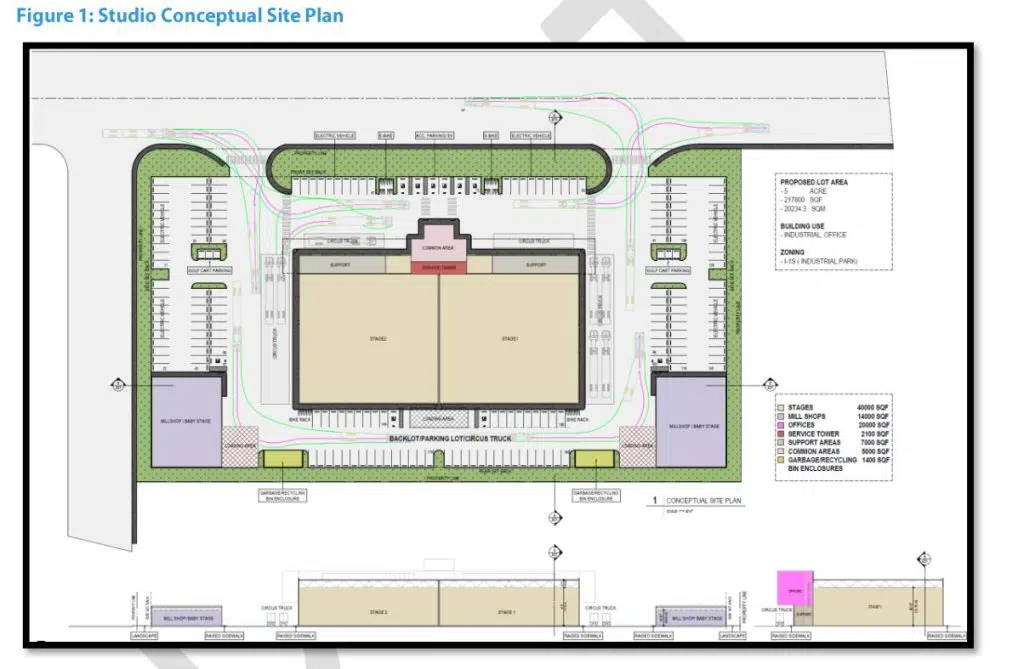
A conceptual site plan for the Kamloops film studio. (Photo via Nordicity)