




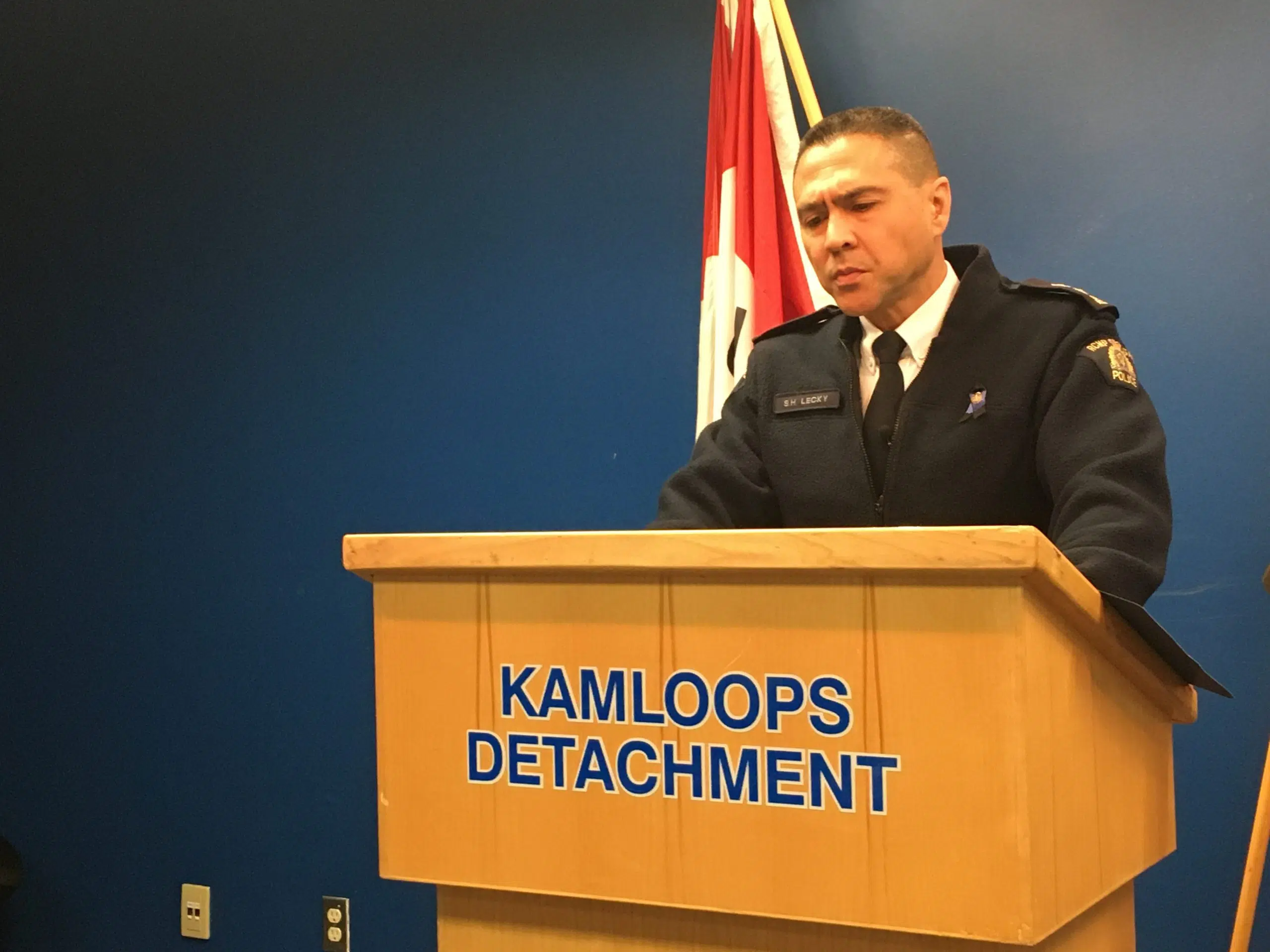
The head of the Kamloops RCMP is in favour of decriminalizing drugs for personal use, but not to the extent currently proposed by the provincial government.
While some advocates of the decriminalization are pushing for the elimination of the 4.5 gram quantity limit entirely, Superintendent Syd Lecky says he feels that amount is far too high.
“Four-and-a-half grams is an incredible amount,” Lecky told council. ” A tenth of a gram can kill somebody.”
Section 56 of the Controlled Drugs and Substances Act allows the Health Minister to exempt “any person or class of persons” if the minister believes that “the exemption is necessary for a medical or scientific purpose or is otherwise in the public interest.”
According to a report in the Vancouver Sun, B.C., Toronto, and Vancouver have all asked Ottawa for Section 56 exemption requests, which would decriminalize the possession of small amounts of substances like cocaine, heroine and fentanyl
In its application to Health Canada, British Columbia seeks to establish a threshold quantity at 4.5 grams for opioids, cocaine and methamphetamine. The submission also noted that the province is willing to work with Health Canada to define thresholds for other substances.
Lecky did not have an amount in mind that he felt would be appropriate to be considered for personal use, noting it should be done on a drug by drug basis.
“If decriminalization does come, we then realize that we will [also] need other tools to be able to do our job. Because right now, there is very little I can do,” Lecky added.
“I might be able to approach you in the park for drinking an open can of beer, but I won’t be able to do much with you if decriminalizing comes through as proposed with those incredible amounts of illicit drugs.”
As currently proposed, Lecky noted police would not be able to arrest a person for drug trafficking if they have four grams of illicit drugs, noting it is mainly traffickers who have that amount of illicit drugs on them at any one time.
Decriminalization has been among proposed solutions as B.C. continues to grapple with an overdose crisis, which was declared a public health emergency in B.C. in 2016. In 2021, there were a record 2,232 overdose deaths in British Columbia, 78 of which were in Kamloops.
The new year began with another 207 such deaths across B.C. in January, including a monthly record of 11 in Kamloops.
Speaking to the Globe and Mail last November, Leslie McBain, a co-founder of Moms Stop the Harm, said while B.C.’s move to decriminalize personal possession is a step in the right direction, she felt there was more that needed to be done before it was sent to Health Canada.
“For example, and importantly, there is no mention of decriminalization of youth who may possess illicit substances,” she said.
“What is written and not written into this submission for decriminalization will affect our children for the future. If they are not protected under this application, they can be thrown into the criminal justice system for possessing any amount of illicit substance. That is no way for them to start their lives.”
Among people who have called for the decriminalization of drugs include B.C. Provincial Health Officer Bonnie Henry, former provincial health officer Perry Kendall, and the Canadian Association of Chiefs of Police.
“We know that shaming those who use drugs is not a solution. We need people who use drugs to know that they can come out of the shadows,” Henry said in August 2020. “You don’t have to use alone because of fear of judgement and incrimination. We need to have the conversations that might make a difference in that person’s life.”
Advocates for drug policy change in Kamloops says they are “tired” of politicians who aren’t acting quick enough to stop the overdose crisis.
“It is completely political. I think stigma plays a part in it,” Sandra Tully told NL News. “Everybody wants to be re-elected and if I sign up for supporting you know X,Y, and Z, maybe I won’t get elected. We are talking about lives here. We are talking about actual people dying. That should be in the forefront versus keeping your party in power.”