




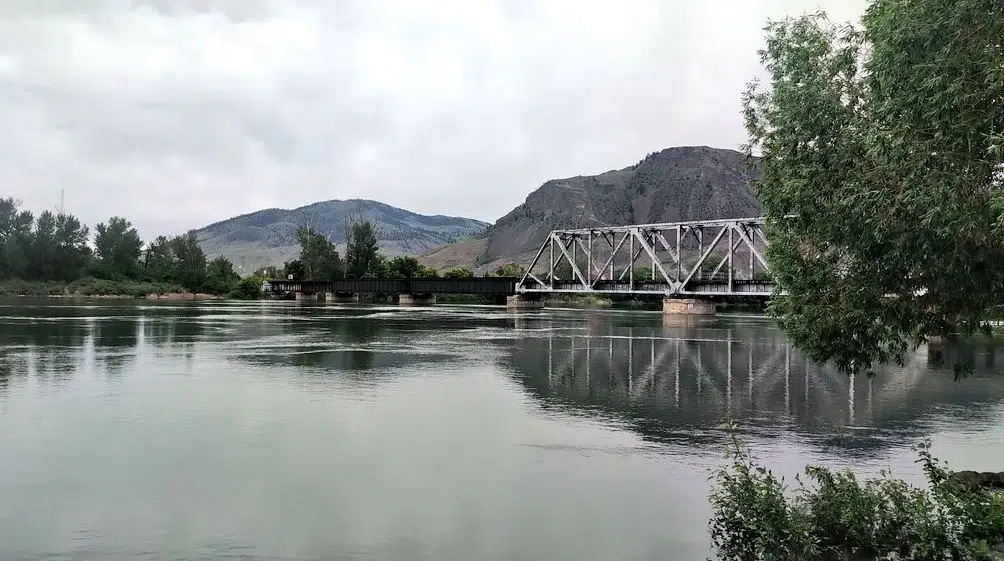
High water on the Thompson River in Kamloops on June 9, 2022 (Photo via Victor Kaisar)
The City of Kamloops says the weather over the next few seven to 10 days will determine severity of flooding on the Thompson River this year.
Utility Services Manager, Greg Wightman, says if Kamloops doesn’t see an extreme weather event in the near future, the city will be “in significantly better shape than we are right now.”
He said while the latest snowpack numbers – 175 per cent in the North Thompson and 157 per cent in the South Thompson – look “drastic,” the upcoming weather forecast appears to be favourable, at least so far.
“As of right now, with a forecast that could change any moment throughout June, we need to be prepared, and the entire community does for something that could be very drastic,” he added. “Fortunately, since the middle of May, we just haven’t had [extreme weather].”
“We’ve had a couple of thunderstorms roll through town, but we haven’t had an extreme weather event. Looking at the seven-day forecast there doesn’t appear to be anything in there, but obviously that changes daily, so we are going to continue to monitor [things] and just stay as prepared as we can for what is coming down the river.”
Wightman said a high snowpack and delayed snowmelt – both of which Kamloops has experienced this year – are two of the three factors that lead to a bad freshet. Extreme weather is the third.
“We’re not worried about the snowpack any more, we’re not worried about the cool spring that has passed, it is just extreme weather,” Wightman said, noting extreme weather will is four to five days of above average heat or a short period of very heavy rainfall.
The City will be closing boat launches tomorrow with staff also removing the railings from the pier at Riverside Park among other things.
Wightman also says a pair of new dykes at McArthur Island and Riverside Park will protect the infrastructure within the park to a one-in-20-year flooding event, reducing the reliance of temporary flood protection measures seen in years past.
“If we do get a similar situation [to] 1999, we won’t be reliant on the deploying of temporary flood protection measures. We have the infrastructure in place now to protect against that,” Wightman said.
“Getting into next week, certainly into the middle of next week, if we do have some weather, that is when we are going to be seeing our high water, [though] the peak of the river is probably not going to happen until the end of the month, so we got a few weeks left of being worried.”
Speaking during a press conference Thursday, the head of the BC River Forecast Centre, said a number of rivers in the province are vulnerable because of the high snowpack that is expected to melt in the coming weeks.
“We really have turned a corner, so over the last couple of weeks we’re seeing that snow is melting, it’s starting to bring up the rivers around the province,” Dave Campbell said, noting only about 20 per cent of the province’s snowpack has melted, instead of the normal 50 per cent at this time. “Many of them are approaching near capacity for the amount of flow that they can handle.”
“This really brings us into what is going to be the critical window for freshet season across the province over the next two or three weeks. We are expecting that with these rivers full, we are very much vulnerable to any kind of extreme weather pattern that might emerge.”
Environment Canada meteorologist Armel Castellan added temperatures over the next month or so are expected to remain below normal, with wetter weather conditions in Southern B.C. as well.
“This continues the trend that we have started in early April. Cooler and wetter conditions have prevailed very systematically,” he said. “We’ve come closer to seasonal values of late, but we are looking to dip down back to the pattern of unstable and cooler weather.”
Until that risk of flood subsides, Wightman is urging Kamloopsians, especially those who live on or near the river, to protect their properties.
“We’ve made sand and sandbags available for residents and we’re seeing a lot of people take advantage of those resources. This is the time to do it,” he said. “We’ve got a little bit of a window here to be proactive.”
“In a lot of cases, we’ll be deploying temporary flood protection measures if it is going to impact infrastructure or roadways or transportation. But a lot of times, that means that the folks living right on the river are outside of that protection zone,” he added.
“That’s why we make these resources available to people living on the river. And again, the time to do that is now.”