




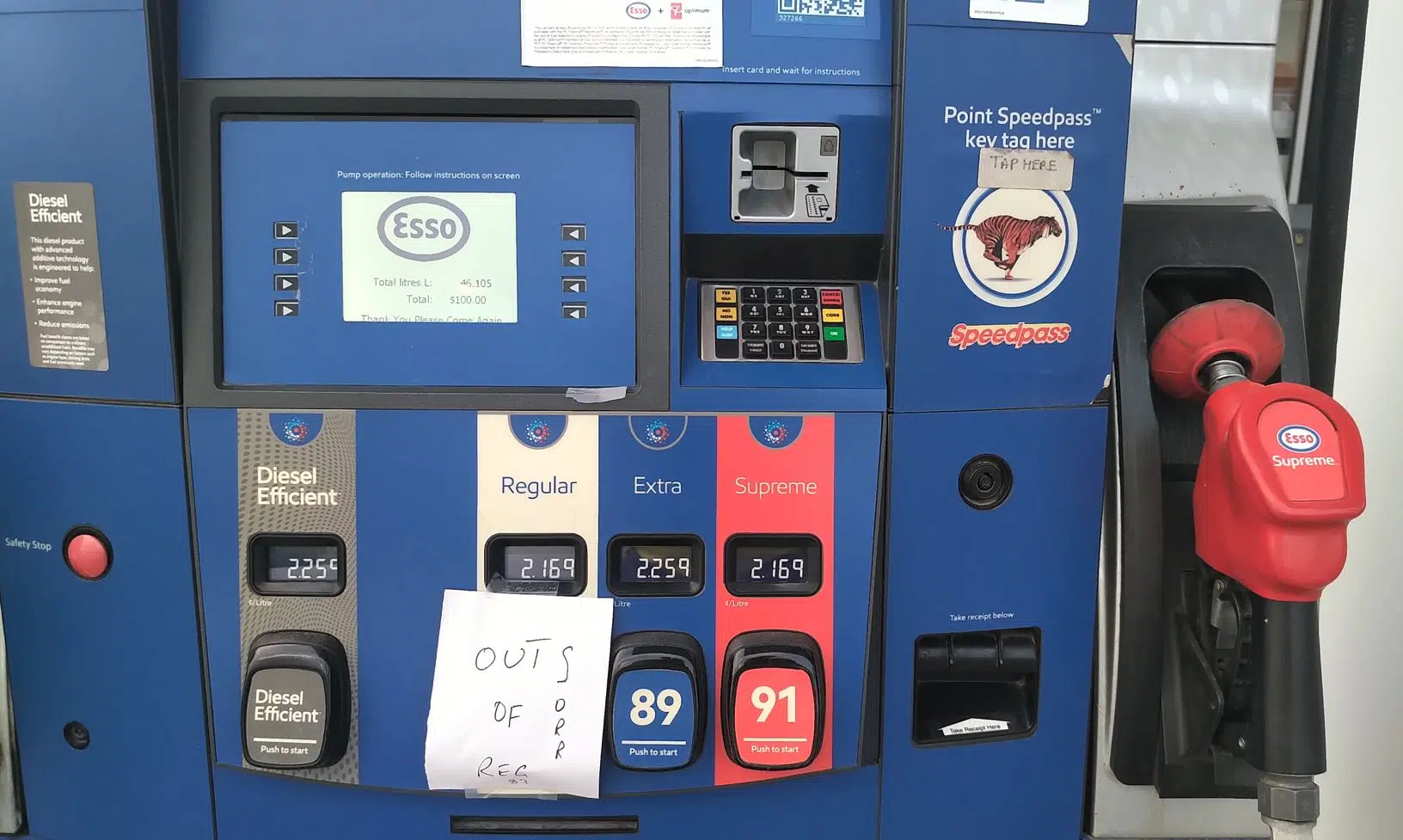
An Esso gas station in Kamloops with no regular gas. (Photo via Victor Kaisar)
While many drivers in the Kamloops region may have noticed gas pumps closed due to a lack of fuel, many people have been scratching their heads as to why these shortages are happening.
University of Alberta Forests and Natural Resource Economic Policy professor Dr. Marty Luckert says the fuel shortages in Canada are a result of new renewable fuel mandates implemented by US President Joe Biden.
“In June, the United States increased their renewable fuel mandate requirements, which caused a bit of a shortage on the ethanol. So there is more (ethanol) now required in the United States and because we import from the United States, that trickles up to us, and there is just not as much around,” he explained.
“So there is some juggling happening right now, with respect to trying to get whatever ethanol is being produced around to where it needs to be to meet those mandates, which have increased in the United States, which we still have in Canada.”
In the meantime, Dr. Luckert says refiners in Canada are looking at pulling ethanol from feedstock, specifically canola.
“Right now, almost all the ethanol in the world is coming from food, and that’s what they are trying to get away from, but in the shorter run, there is going to be increased pressure on the food chain too.”
“One of the prospects for canola is right now is there’s roughly 10 to 20 per cent (in the bad years) that the canola seed is not necessarily good for producing food-grade canola oil. So there is a substantial amount there right now, that could potentially go into a separate supply chain,” he explains.
“Some of the problems associated with using food for fuel is it creates increases in food prices, and of course, we witnessed that in the United States, in Mexico, and even in Canada and the public is pretty well afraid of that, especially during a time of inflation.”
Additionally, Dr. Luckert says there is a high demand for fuel right now due to increased travel coming out of the pandemic, summer tourism, and the war in Ukraine, which has also affected the higher prices at the pump.
However, he says the saving grace regarding the strained ethanol supply chain and high fuel prices could be a recession.
“Oil, gas, and fossil fuels track economic output very closely and our economies run on fossil fuels. So to the extent that we have bad economic performance, the demand for fossil fuels goes down and we don’t consume as much,” explains Dr. Luckert. “We saw this during COVID, oil went plummeting because the economy was virtually shut-down in a lot of areas for some time; therefore, the gasoline demand and other fossil fuels dropped precipitately.
“Well now the economy is going up again, but if we fall into a recession, which is defined as decreased output, that influences the gasoline demand, and we could see some price easing in that respect.”
As for when there could be some relief on the fuel supply chain, Dr. Luckert says it’s a million-dollar question.
“It seems as though the fuel is going to be tight for a while given the Ukraine and Russia situation, and as long as fuel is tight, the prices are going to be high,” he says.
Dr. Luckert suggests high oil prices could be a blessing in disguise for the ethanol and fuel supply chain issues.
“If there is some response to that with less gas being consumed, then the requirements of those extra mandates they just put on in the United States could be less because people are buying less gas overall.”
At least two gas stations in #SalmonArm are currently out of fuel: @Shell @petrocanada. It comes one month after #ImperialOil told @RadioNLNews the gasoline shortage in #Kamloops last month was due to an #ethanolshortage at the Suncor Kamloops Terminal. pic.twitter.com/SbjZqTEG0n
— Abby Zieverink (@ZieverinkAbby) July 31, 2022