



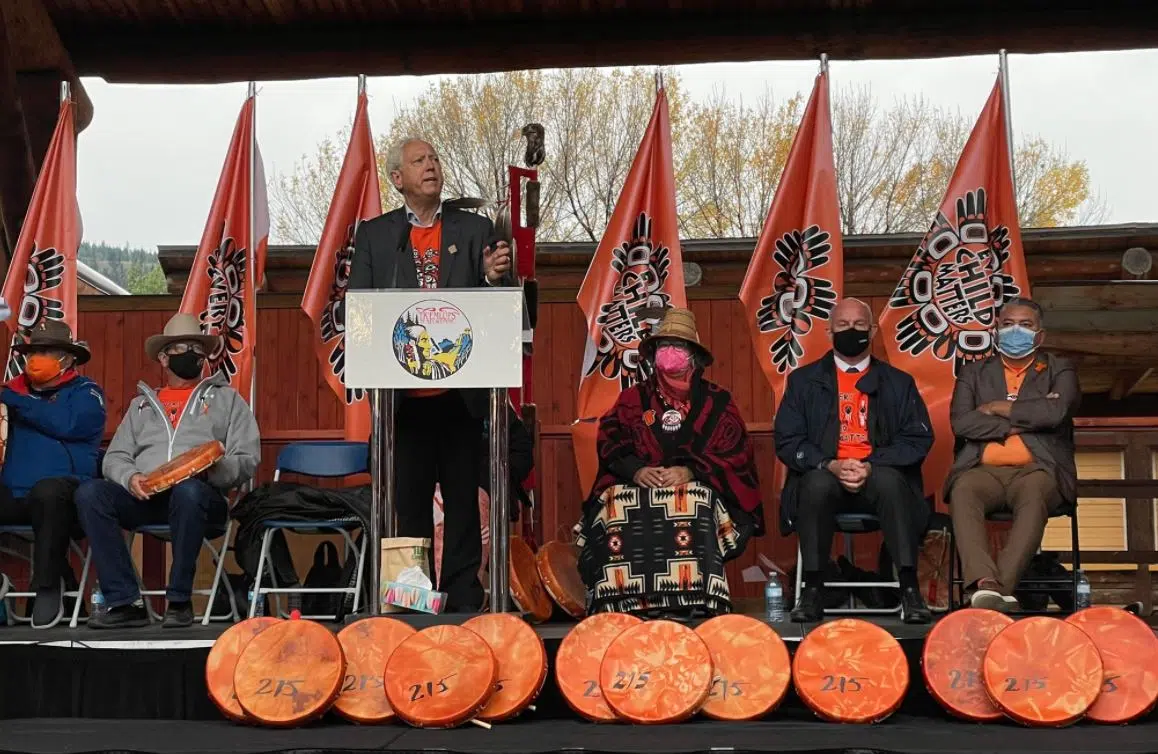
B.C. Minister of Indigenous Relations and Reconciliation, Murray Rankin, speaking at a ceremony marking the first National Day for Truth and Reconciliation at the Tk’emlúps Powwow Arbour Grounds. (Photo via Murray Rankin)
B.C.’s Minister of Indigenous Relations says a decision on whether or not to make National Day for Truth and Reconciliation into a statutory holiday are still ongoing.
Speaking on the NL Morning News, Murray Rankin, says that decision will be made after speaking to residential school survivors as well as Indigenous people and communities across the province.
“We don’t take for granted that they would want a day, and we want to make sure what they think should happen. That conversation is going on,” Rankin said. “As well, we are talking with employers groups and workers groups to see what they think should happen, that work is ongoing.”
“I am sure over the next year we’ll have some announcements to make about the work that follows that consultation.”
So far, just New Brunswick, Prince Edward Island, the Northwest Territories, and Nunavut have followed the Federal Government’s lead and declared Sept. 30 a statutory holiday.
Saskatchewan, Ontario, and Quebec appear to have no plans to follow suit, while Alberta has left the decision up to employers. Consultations on whether the day should be a statutory holiday are ongoing in Manitoba, Nova Scotia, Newfoundland and Labrador, and Yukon.
Here in B.C., the provincial government has said the earliest that changes can be made under the Employment Standards Act would be for 2023 so that employers and workers understand the potential impacts should a new statutory holiday be created.
“[While] we haven’t done what the federal government has done which is made it a statutory holiday applying to the provincially regulated employers under B.C. law, a lot of our trade unions have in their collective agreements, a clause that says they will be given those days that are statutory holidays at the Federal level,” Rankin said.
“So for the public sector, by and large, today is a holiday.”
Until a decision is made, the B.C. government says the private sector is being encouraged to recognize National Day for Truth and Reconciliation in a way they see fit.
It will be at the discretion of other workplaces how to recognize the Day. Some collective agreements, including provincially regulated employees, may already recognize the federal holiday as a paid day.
“Private sector employers with provisions on statutory days may also want to observe the day as they did last year,” the province said, in an update online.
“For this year, the Province is advising public sector employers to observe the day in the same way as they did last year. We expect many private sector employers will choose to do the same.”
Last year, Rankin told NL News it is likely a case of when and not if National Day for Truth and Reconciliation will become a statutory holiday in British Columbia.
He also compared it to Remembrance Day, which is a stat holiday in places like Alberta and B.C., but not in Ontario and Quebec.
“Every province is different,” Rankin said. “I remember vividly in Ontario going to school assemblies on Remembrance Day etc., and having veterans come and talk to us.”
“Now, all the schools [in B.C.] are of course doing a lot of National Truth and Reconciliation Day activities leading up, and I suspect that will continue if it is a provincial statutory holiday in the future.”
“But there are two sides to the argument,” Rankin added. “That is precisely why we are doing the consultation.”