




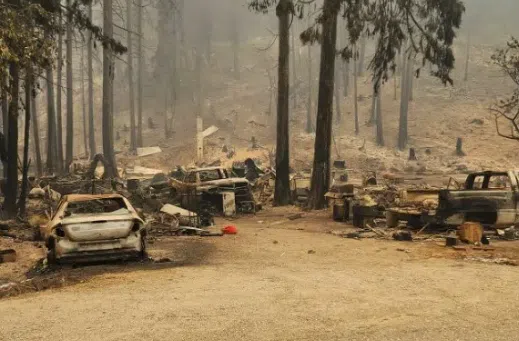
Damage left behind from Bush Creek East Fire/via Mel Kovaltsenko/Facebook
Local leaders in the Southern Interior are expressing frustration and disappointment with a lack of provincial transparency connected to the recently-legislated changes to the Emergencies Act.
Among the concerns, confirmation that First Nations in BC were able to sign non-disclosure agreements with the Province to preview and consult on the draft of the new Emergency and Disaster Management Act before it was introduced in the Legislature on October 3rd, while municipal leaders were not afforded the same courtesy.
This revelation has drawn the ire of local leaders in Kamloops and other parts of the region.
Councillor Mike O’Reilly suggests regional hubs, such as Kamloops, which played host to hundreds of wildfire evacuees from various parts of the region this summer, have a vested interest in what the new Act will mean for the city.
“The amount of people that we actually host in Kamloops from natural disasters is significantly higher than most other places, I would suggest, in British Columbia,” O’Reilly said as part of a city council meeting on November 21st. “We are the evacuee host of Canada.”
For its part, the Ministry of Emergency Management and Climate Readiness contends local leaders were given ample time to provide input on potential changes to the Act, noting its been in the works since 2018.
“The Province conducted a broad public engagement process over multiple phases to ensure partner feedback was considered in drafting the new legislation,” said the Ministry in a statement to Radio NL confirming that First Nations were provided a first-hand look at the draft legislation before it gained Royal Assent on November 8th. “The Ministry of Emergency Management and Climate Readiness held meetings with First Nations, local governments, various Union of BC Municipalities committees and working groups, Crown corporations and agencies, provincial and federal ministries, non-profit groups and other groups with a role to play in emergency management.”
Sources within the emergency management field have told Radio NL the lack of consultation with municipalities has left them frustrated, as their First Nation counterparts — whom they tend to work with closely on disaster management plans — were unable to have fulsome conversations with them as discussions around the new legislation were taking place.
The Emergency Management Ministry has defended its use of non-disclosure agreements to allow First Nations access to the draft.
“Non-disclosure agreements are a tool used by government to share confidential information with partners. As this was one of the first pieces of legislation developed with First Nations Peoples, the Province is committed to continuing to evolve the process to ensure it’s inclusive and transparent,” the statement from the Ministry reads. “In some instances, where documents are being developed for Cabinet and shared beyond the provincial government, confidentiality agreements ensure that the government can do its work in a way that respects parliamentary privilege. This allows the legislation to remain confidential until it is introduced in the legislature for first reading.”
While the province is still soliciting input on potential revisions, municipal leaders like Barriere Mayor Ward Stamer say there are still a lot of outstanding questions that need answers before the spring freshet season hits.
“To be able to fully explain to the municipalities exactly is going on and what the impacts will be in laymen’s terms, and not just give us a 250 page document and say ‘here you go,'” said Stamer.
Despite pushing through the new Emergency and Disaster Management Act earlier in the month, the Ministry of Emergency Management and Climate Readiness points out that it’s still soliciting feedback on potential revisions.
“The Emergency and Disaster Management Act outlines a modernized framework for emergency management and regulations are now being developed to operationalize this new approach,” the statement to Radio NL reads. “The Province is currently seeking input and feedback from local governments, First Nations small businesses and people on associated regulations, including the local authority emergency management regulation and the post-emergency financial assistance regulation. Ministry staff have been holding virtual workshops for communities, small businesses and people across B.C. to provide input on these regulations.”
The window for submissions is due to close by the end of the year.
Kamloops City Council is drafting a letter to the province looking for further clarity about the new Act, while also requesting that provincial funding be made available to meet its requirements, which it worries could download more costs on municipalities who host evacuees from natural disasters.