




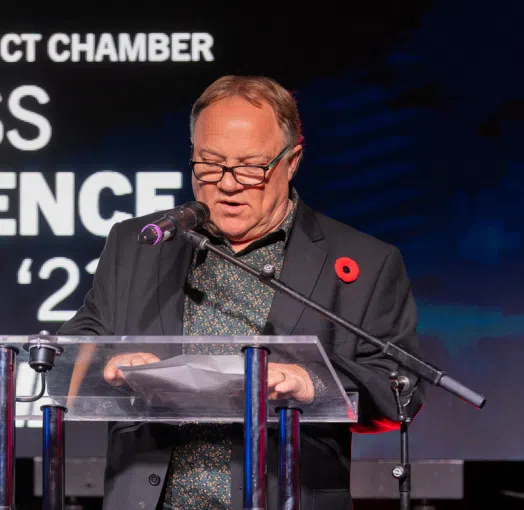
Kamloops Mayor Reid Hamer-Jackson. (Photo via Kamloops Chamber of Commerce)
Kamloops City Council and lawyers for the city are considering their next moves after the mayor hand-delivered two sets of confidential documents from two different closed-council meetings to multiple media outlets across the city.
Speaking on NL Newsday, city councilor Mike O’Reilly says Reid Hamer-Jackson has exposed the city and taxpayers to potential legal liabilities exceeding $1-million.
The mayor spent much of last Friday delivering unredacted copies of the findings of an external investigation conducted into alleged breaches of the city’s Code of Conduct by Hamer-Jackson.
Known now as “The Integrity Group Report”, investigator Terry Honcharuk found Hamer-Jackson breached Code of Conduct rules on 12 separate occasions with three different city staffers.
In various interviews the mayor claimed the report was left in the mailbox at his home, and was allegedly from someone in Tofino, though the mayor “couldn’t remember” the name of the person it came from.
The mayor has long-maintained his innocence in the matter that was the focus of the report, while also claiming he was never told what the specifics of the allegations were.
NL News previously reported on the existence of the investigation, after obtaining emails between Honcharuk and legal counsel for the mayor at the time, David McMillan.
The emails detailed two months of back and forth between the parties as Honcharuk tried to set up a zoom interview with the mayor to get his side of the story.
Through his lawyer, Hamer-Jackson refused to participate, leading Honcharuk to make his recommendations based on the information he had – which excluded any comment from the mayor.
Hamer-Jackson told NL News Friday that he now intends to “defend himself” though he hasn’t specified what venue that may involve.
In the interview Tuesday, O’Reilly was at times providing heavily lawyered answers.
“This is not a leak at all,” O’Reilly said. “They were hand-delivered to multiple media outlets.”
“Its important to know that the mayor’s recent conduct of releasing this, his behavior in relation to city staff and public statements in the media interviews may well constitute among other things, contraventions of the laws governing conflict of interest, confidentiality obligations under the Charter, privacy allegations under the Freedom of Information and Privacy {Protection} Act and the obligation under the Community Charter not to hinder, or obstruct a municipal officer or employee in the exercise of the performance of his or her powers.”
When specifically asked about the potential for the city to file a court injunction against the mayor, O’Reilly replied all options were on the table.
“It’s unlawful,” O’Reilly added.
“[The mayor has] exposed the city to significant potential loss and damage in the forms of various types of lawsuits, and you can pick a thread here but there’s constructive dismissal, defamation, breach of privacy – the cost of defending against those potential lawsuits and the various legal claims which together could involve very substantial monetary bills and liability in the excess of $1-million, would ultimately be borne by the taxpayers.”
When specifically asked about the potential for the city to file a court injunction against the mayor, O’Reilly replied that “all options were on the table.”
“It’s unlawful. He’s exposed the city to significant potential loss and damage in the forms of various types of lawsuits, and you can pick a thread here but there’s constructive dismissal, defamation, breach of privacy – the cost of defending against those potential lawsuits and the various legal claims which together could involve very substantial monetary bills and liability in the excess of $1-million-dollars, would ultimately be borne by the taxpayers.”
Kamloops is not the first city in British Columbia to face a situation like this.
In 2011, Prince George city councilor Brian Skakun was convicted of breaching section 30.4 of the Freedom of Information and Privacy Protection Act.
In that case, Skakun admitted to taking a similar code of conduct report to the CBC.
He was subsequently ordered by the court to pay a fine of $750, though the statute allows for a maximum fine of $2000.
News reports at the time say Skakun’s legal expenses in the affair topped $50,000 – which he didn’t have to pay because he found a lawyer who took the case Pro-Bono.
Skakun found himself with a number of other allies in the public, and in the editorial pages who cast him as a whistleblower.
He appealed the decision but it was upheld by the Court of Appeal for British Columbia.