




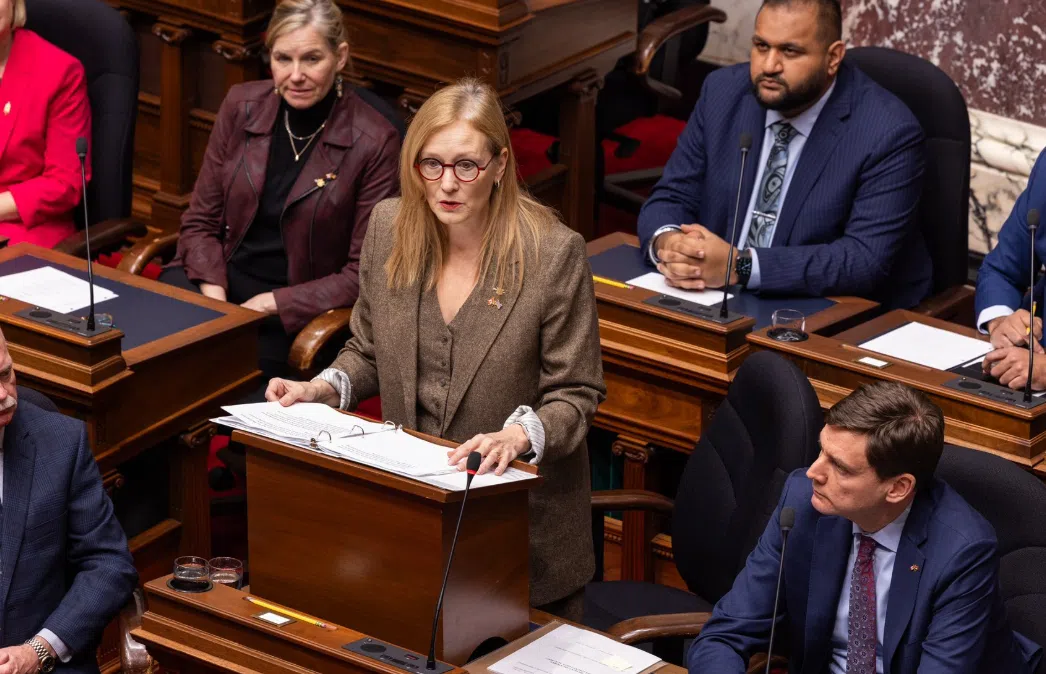
The provincial budget unveiled Tuesday, forecasts the province’s first $10-billion deficit, with the gap between revenue and expenditure predicted to hit $10.9 billion in 2025/26.
Last year’s budget initially forecast a 2024/25 deficit of $7.9 billion – a record at the time – before a series of revisions saw it adjusted to $9.1 billion. The government predicts the deficit will fall to about $9.9 billion in 2027/28.
The budget includes an annual contingencies fund of $4 billion for each of the next three years.
It sets aside the funding for “uncertain or unforeseen matters,” that include collective bargaining costs, future initiatives and responses to the trade war with the United States.
Finance Minister Brenda Bailey says the budget doesn’t have “splashy new announcements,” but the budget isn’t broadly slashing spending in response to the trade war with the U.S. with spending actually set to increase over the next three years in the fiscal projection.
Consolidated operating expenses total $94.9 billion in 2025/26, rising to $98 billion by 2027/28. Capital spending in 2025/26 meanwhile rises from a forecast of about $19 billion in last year’s budget to a forecast of $20.2 billion in the new budget.
Conservative Finance Critic and Kamloops Centre MLA Peter Milobar is calling for more to be done on the issue of inter-provincial trade.
Milobar says there is no mention in the document of how BC will make it easier to trade with our domestic partners. “We know that interprovincial trade is a 23% tariff equivalent to British Columbia. we know that New Brunswick today actually removed barriers immediately on things like alcohol moving between provinces. Nova Scotia had tax relief in their budget introduced last week, even in the face of tariffs promised tax relief for business and for residents. Yet this government, despite the fact they made campaign promises, has not followed through on any other campaign promises in this budget.”
“Trade, before tariffs year over year, is down 3% in BC. Exports are down 3%. We were already facing troubles heading into this budget, yet this minister and this Premier is trying to convince everybody that this is strictly based an $11 billion deficit on the uncertainties around tariffs.”
Other Reaction
Former provincial health minister Terry Lake, now the chief executive of the BC Care Providers Association, says Bailey’s budget has little new programming, and most of the capital projects in the document have already been announced. Lake says the province could have taken a bigger step in updating its procurement model, which he says could have built more with the same amount of money.
Fiona Famulak, President and CEO of the BC Chamber of Commerce, released the following statement in response to the release of Budget 2025 by the Government of British Columbia. “Budget 2025 was unveiled in unprecedented challenging times. The context in which our province and nation are operating has fundamentally changed overnight.”
“Today’s budget is sobering for both businesses and British Columbians. It does not deliver the economic incentives, tax changes, programs or policy shifts that are required to kick-start our economy and which we have been advocating for since before the last election.
The Canadian Taxpayers Federation is calling on the B.C. government to cut spending now, in the wake of the deficit. “Sky-high spending by this government is fueling tax hikes and massive borrowing,” said Carson Binda, B.C. Director for the CTF. “While your family is going to be slammed with a carbon tax hike on April 1, Premier David Eby is padding his premier’s office budget by more than a million dollars this year.”
Despite assurances that B.C. will scrap the provincial carbon tax once Ottawa removes the federal backstop, B.C.’s budget continues to forecast carbon tax revenue into 2028 and beyond. “Everyone who has a chance of being our next prime minister, from Mark Carney and Chrystia Freeland to Pierre Poilievre, has already committed to scrapping the carbon tax,” Binda said. “Forecasting carbon tax hikes moving forward, despite commitments to cancel the tax is dishonest budgeting which Eby needs to explain.”
Kim Haakstad, President & CEO of the BC Council of Forest Industries says COFI welcomes the BC Government’s focus on responding to the threat of new US tariffs in Budget 2025, but it is disappointed by the absence of dedicated support for the forest sector. “As Premier Eby and Minister Parmar have acknowledged, the forest sector will be particularly hard hit by the new tariffs at a time when the industry is already facing significant challenges. These broad-based tariffs apply to all forest product exports—including pulp, paper, packaging, engineered wood, and mass timber—adding further pressure on workers, companies and communities already affected by softwood lumber duties.”
“There is no one simple fix for the challenges facing BC’s forest sector, but ensuring predictable access to sustainable and economic fibre is critical to maintaining jobs and supporting operations across the province. ”
Here’s a look at some of the budget’s key numbers and the tariffs’ projected impacts on B.C.
$10.9 billion: Estimated 2025/26 deficit, up from $9.1 billion in 2024/25
$20.2 billion: Estimated 2025/26 capital spending, up from $16 billion in 2024/25
1.8%: 2025 real GDP growth, up from 1.2% last year.
$110 rebate for ICBC customers
$43 billion: Projected cumulative GDP losses by 2029 due to U.S. tariffs
45,000: Jobs lost by 2029 under tariffs
6.7% : Projected unemployment in 2026 under tariffs
$1.7 billion – $3.4 billion: Potential annual revenue losses under tariffs