



As wildfires grow more frequent and severe across B.C., a new cultural mapping initiative in Kamloops is helping residents rethink their relationship with fire, resilience, and preparedness—one story at a time.
Led by Thompson Rivers University researcher Will Garrett-Petts and supported by a Wawanesa Wildfire Community Resilience Grant, the project uses a participatory method called cultural mapping to uncover how individuals and communities experience wildfire events, and how they understand—and adopt—mitigation tools like FireSmart.
“When we ask people to engage in cultural mapping, it’s a deep visualization exercise,” says Garrett-Petts. “They create a visual representation of how wildfires have affected them, their homes, or their neighbourhoods. And when they walk us through their maps, they’re really telling the story of their experience in great depth.”
The research, based out of the Kamloops Museum and Archives, has revealed an unexpected disconnect. While 84% of British Columbians surveyed say they believe in the value of FireSmart, and 60% of those familiar with it go on to seek more information or adopt its methods, a staggering 76% remain unaware or unfamiliar with the program altogether. “Being FireSmart means being fire aware,” Garrett-Petts says. “But there’s a huge awareness gap—and we don’t yet fully understand what’s motivating it.”
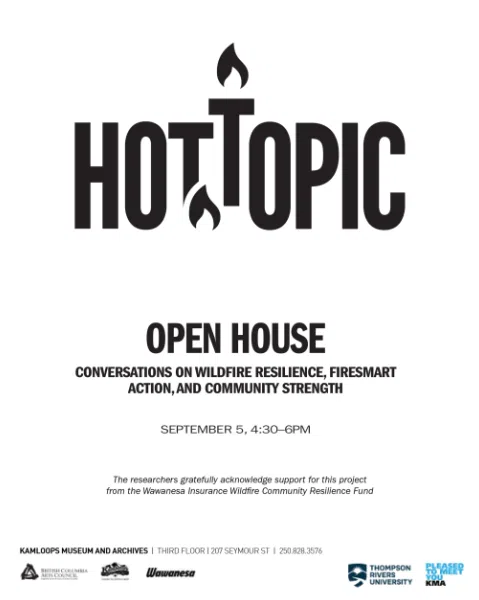
To explore those questions more deeply, the project is hosting a public event, the Hot Topic Open House, on Friday, September 5 from 4:30 to 6:00 p.m. at the Kamloops Museum and Archives. The free event is being co-hosted by Thompson Rivers University and will feature short talks, roundtable discussions, music, refreshments, and hands-on cultural mapping activities.
The goal? To bring the public, researchers, and experts together for an open conversation about wildfire risk, resilience, and the power of community knowledge. “Cultural mapping has been used around the world as a way to bring people into conversations they’re often left out of—like disaster planning or land-use policy,” says Garrett-Petts. “We’re building a research model where those voices are not only heard, but are shaping real responses.”
The evening will include brief presentations from a wide panel of guests, including:
- Chief Ken Uzeloc, Kamloops Fire Rescue & Director of Protective Services
- Kathleen Calhoun, Kamloops FireSmart Liaison
- Dr. Gillian Harvey, TRU Canada Research Chair in Fire Ecology
- Christy Rintoul, United Way
- Researchers from the TRU Wildfire Institute
Don’t be put off by the number of speakers,” Garrett-Petts says. “Each one will speak for just a few minutes to frame key issues, and then we’ll open the floor for a community conversation. We already have over 40 RSVPs—we know it’s going to be a packed and passionate room.”
This event marks a key milestone, but it’s far from the end. The research project will continue through April 2026, with plans to expand mapping into Kamloops’ 17 to 19 active neighbourhood associations, and to include unhoused and precariously housed populations in the process.
“This is just the beginning,” says Garrett-Petts. “We’re trying to understand how awareness spreads, and what it takes to make wildfire resilience something everyone sees themselves as part of.”