




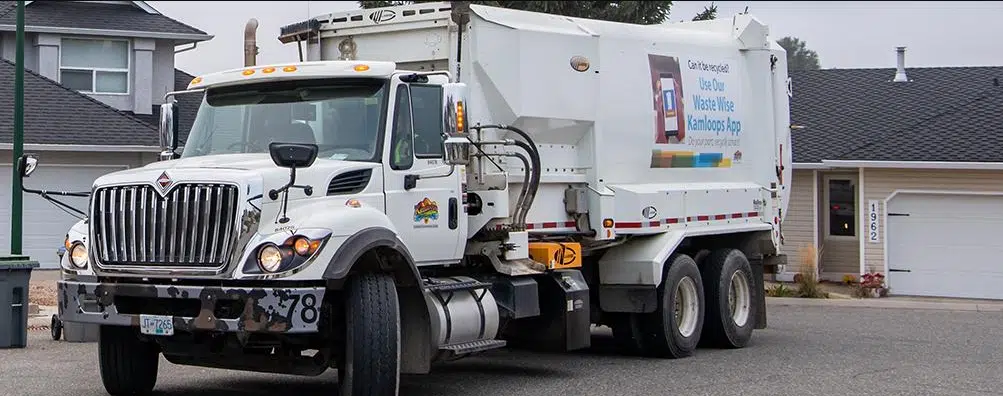
Photo via City of Kamloops
In a bid to address the city’s most common service complaint—missed waste collection—the Governance and Service Excellence Committee received an update this week on an innovative, low-cost solution that could dramatically improve tracking and response times.
Greg Wightman, the city’s Manager of Solid Waste Services, presented the update as a follow-up to a 2024 business case focused on waste collection technology. The original plan centered on AI systems to detect contamination in organics, but staff have since shifted attention toward a new challenge: missed cart pickup calls, which accounted for 2,400 complaints last year—35% of all solid waste service calls.
“Missed collection is the single largest complaint we receive,” Wightman told the committee. “It’s not just frustrating for residents—it’s a major operational burden.”
High Volume, Low Error Rate
Despite the number of calls, Wightman emphasized that the city’s overall collection success rate remains high. With 2.8 million residential carts collected annually, the missed pickup reports represent just 0.07% of total collections.
However, responding to complaints is time- and resource-intensive. Staff estimate roughly 1,200 work hours—costing about $45,000 to $50,000 annually—are spent verifying, investigating, and responding to these calls.
Complicating the issue is the lack of current technology to verify when carts were or were not placed at the curb in time. Drivers often rely on memory and GPS data, leaving city staff with limited evidence when responding to complaints.
RFID vs. App: A Cost-Driven Pivot
Many cities have turned to RFID (Radio Frequency Identification) tags, which can be scanned by trucks to confirm a cart was collected. While the city already uses RFID tags on its newer organics carts, retrofitting the rest of the city’s carts—three per household across 27,000 homes—would cost an estimated $750,000.
Instead, staff developed a free, in-house app solution in collaboration with the city’s GIS team.
The app will require drivers to log whether a cart was present and collected or not present at each address. Drivers will use vehicle-mounted iPads, and the app will not allow them to complete their route without entering data for every property. The system also sends real-time updates to the city’s call center, potentially allowing staff to respond to resident complaints within minutes.
Wightman acknowledged the system is “a bit onerous” for drivers and adds about five seconds per stop, but early estimates suggest the time added is manageable and might be offset by reduced time spent responding to complaints.
“We believe this will actually slow drivers down just slightly in a good way—giving them a moment to input data and take a brief pause,” said Wightman.
Council Reaction: Cautious Optimism
Council members expressed support for the pilot, while acknowledging the added burden on drivers.
Councillor Mike O’Reilly praised the professionalism of collection drivers and noted that many complaints are “alleged” missed pickups—cases where residents may have simply placed their carts out too late.
“Drivers aren’t just operating trucks. They’re highly skilled and engaged the entire time they’re working,” O’Reilly said. “This tool might actually validate their work and reduce those unfair complaints.”
Councillor Katie Neustaeter commended staff for their creative, cost-saving approach. “It’s an extra checkbox for drivers, but a potentially huge win for the city and for residents,” she said.
Neustaeter also raised the possibility of future RFID retrofits if the app-based solution proves insufficient. Wightman confirmed there is no current funding plan to expedite RFID installation but said the city would revisit that option depending on the app’s performance.
Councillor Bill Sarai also questioned whether the added responsibility would impact drivers’ shifts or lead to overtime.
Wightman clarified that the goal is to keep the new system within regular working hours. “We estimate about five seconds per property. It shouldn’t push us into overtime territory.”
What’s Next?
The city is currently working to install safe and secure iPad mounts in collection vehicles. The rollout is expected to begin within the next month, pending final equipment installation.
“This isn’t a silver bullet, but it’s innovative, free, and it has the potential to really improve our operations,” said Wightman. “And if it doesn’t work, we know there’s another—albeit expensive—option on the table.”
The committee received the presentation as a report for information. Results from the pilot will likely be included in future service reports as staff monitor complaint volume and operational impact.