




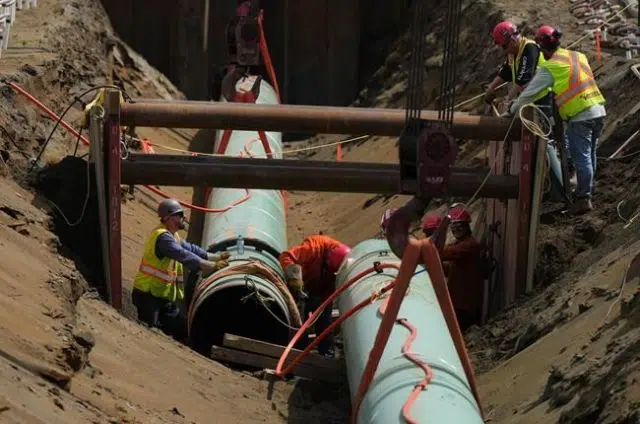
Construction on the Trans Mountain pipeline near Pípsell, or Jacko Lake, near Kamloops. (Photo via The Canadian Press)
The Thompson-Nicola Regional District is calling on the provincial government to postpone planned changes to pipeline property valuations that could reduce industrial tax assessments by nearly a third and shift hundreds of thousands of dollars in tax burden onto homeowners and small businesses.
At issue are BC Assessment’s proposed revisions to its Gathering and Transmission Pipeline Cost Model, slated for implementation in the 2026 assessment roll. The updated model—the first full review in almost two decades—will reduce assessed pipeline values across the region by an estimated 23–30%, translating to a total reduction of roughly $300 million in assessed value within the TNRD alone.
While BC Assessment says the changes reflect updated construction costs, depreciation, and maintenance practices, the TNRD says the move was rushed, poorly communicated, and unfairly timed. “It’s very concerning,” said TNRD Chair Barbara Roden. “This doesn’t change our overall budget, but it shifts the tax burden from pipeline customers to other people within the TNRD—mostly residential taxpayers. We’re talking about roughly $250,000 being shifted onto the backs of residents and small businesses before we’ve even asked for any money for our own operations.”
In a letter to Finance Minister Brenda Bailey, the TNRD formally requested that BC Assessment postpone implementation until reviews of other major utility classes—such as railways, telephone, cable, and electrical transmission lines—are completed. The Board argues that reviewing only one industry at a time creates inequity within the Utilities tax class. “If BC Assessment is planning to review other large-scale utilities next year, then it makes sense for all those changes to be implemented together,” the letter states. “The status quo that has been in place since 1986 should remain for at least one additional year.”
According to the TNRD’s calculations, the pipeline assessment reduction would shift approximately $250,000 in taxes to other property classes within the regional district—primarily residential properties in smaller, rural Electoral Areas that have limited commercial tax bases. In some of those areas, the letter warns, residential property owners could face tax increases of up to 25% before accounting for any other budgetary adjustments or inflationary pressures.
The timing of the change has also drawn sharp criticism. Although BC Assessment began discussions with pipeline companies as far back as 2016, local governments are only just learning of the finalized assessment model, as they are already in the midst of preparing budgets for the coming year. “These talks have been going on with industry stakeholders for nine years,” Roden said. “Pipeline owners like FortisBC, Enbridge, Trans Mountain, and others were all part of it, as was the Ministry of Finance. And yet regional districts and municipalities only found out about it a few weeks ago.”
Roden said the late notice leaves the TNRD “scrambling” to explain unexpected tax shifts to residents and to plan for the 2026 fiscal year. “It’s not just about money—it’s about transparency and fairness,” she said. “This was sprung on us with virtually no consultation.”
At the October 23rd TNRD board meeting, several directors questioned the logic of using a “fixed and immediate depreciation” model, which lowers assessed values regardless of ongoing maintenance or profit. Director Nancy Bepple pointed out that major pipeline companies such as Pembina have seen profits rise sharply in recent years, from $1 billion in 2017 to $2.4 billion in 2024, and argued that depreciation does not reflect the financial realities of the industry.
Roden echoed that concern in an interview, saying pipelines are legally required to be maintained to “like-new” standards to prevent leaks or environmental damage. “So what depreciation are we talking about here?” she asked. “These are not assets that lose value over time in the same way residential properties might.”
The TNRD’s letter emphasizes that the pipeline property class—particularly the Trans Mountain Pipeline—has grown substantially in value following the expansion project’s completion. Reducing the assessed value now, the district argues, undermines the promised financial benefits that were used to justify such infrastructure projects to local communities. “When these projects come into an area, the companies are very bullish about the benefits they’ll bring,” Roden said. “Increased tax revenue is always one of their selling points. Residents deserve to know whether that promise actually holds up over time.”
BC Assessment officials have said the new model will receive regulatory approval in November, Ministry of Finance approval by late November, and final approval by BC Assessment’s Board in December.
The TNRD, meanwhile, plans to rally support from other local governments and First Nations across British Columbia to push for a pause. “We’re already hearing from other regional districts and municipalities who were blindsided, just like us,” Roden said. “This isn’t just a TNRD issue—it’s a province-wide concern about how industrial property is valued and who ends up paying the difference.”
By the Numbers
- $300 million – Estimated drop in pipeline assessed value across the TNRD (27% reduction)
- $250,000 – Projected shift in taxation from pipeline companies to other taxpayers
- 25% – Possible residential tax increase in smaller Electoral Areas
- 1% – Equivalent to nearly 1% of the TNRD’s total $28.8M tax requisition
- Since 2016 – Industry consultation began; TNRD only informed September 2025