




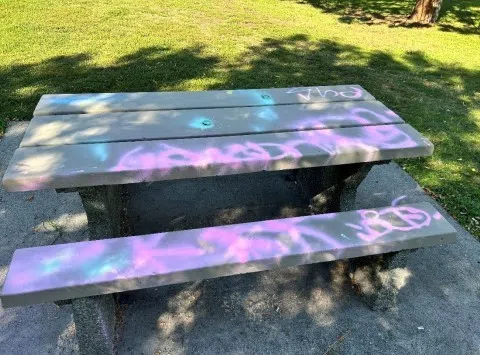
A picnic table in Rainbow Park vandalized with pink and blue spray painted graffiti. (Photo via Kamloops RCMP)
The City of Kamloops says new coordination between business groups, police, and city departments is beginning to make headway in reducing graffiti and improving cleanup response times.
At Tuesday’s Safety and Security Select Committee meeting, Community Services Manager Will Beatty presented an update on the city’s graffiti intervention and prevention initiatives, backed by data showing both progress and continuing challenges.
According to the city’s latest figures, Community Services recorded 151 graffiti incidents on private property and 173 on public property so far in 2025 — down from 299 public incidents last year. The city allocated $160,000 this year for graffiti abatement on civic infrastructure and has spent just under $100,000 to date.
A More Coordinated Approach
Beatty said the city recently launched a new working group that includes representatives from all three Business Improvement Associations, the Kamloops RCMP, and Community Services Crime Prevention staff. “This group intends to meet quarterly to share statistics on hotspots, what’s being seen in the community, and what’s working elsewhere,” Beatty told the committee. “We’re also developing a GIS mapping system to track graffiti incidents and identify problem areas faster.”
The new process allows graffiti-related information to be shared directly with BIAs, whose staff and volunteers can now respond more quickly to cover up or remove tags. Beatty said this has led to faster cleanup times and a deterrent effect, as vandals tend to avoid areas where their work is quickly erased.
Support for Businesses
Councillor Bill Sarai raised concerns from business owners who say they lack the time or expertise to handle graffiti cleanup. He suggested the city consider developing a graffiti task force or a coordinated contractor service that businesses could access easily.
Beatty replied that while the city does not endorse specific companies, it does share information about qualified contractors. In BIA areas, graffiti is often cleaned by BIA teams directly, reducing the burden on business owners. “Anything attached to a BIA, we now deliver those notices to the BIA instead of the business owner,” Beatty explained. “Their workers take care of the cleanup, and businesses simply approve the work.”
Graffiti on Murals and Public Art
Councillor Stephen Karpuk questioned whether graffiti targeting public art and murals — often funded by local businesses — has declined. Beatty said data currently does not separate graffiti on art pieces from other reports, but city staff are exploring ways to geo-locate specific sites to monitor those incidents.
Karpuk also asked about the sale of spray paint and other materials used in graffiti, suggesting that retailers might require ID for purchases. Beatty said such policies would be difficult to enforce without creating costs for businesses, but discussions about prevention strategies — including store-level restrictions and reward programs for reporting graffiti — are ongoing among partner agencies.
Enforcement Challenges and Prevention Focus
Beatty and Kamloops RCMP Superintendent Jeff Pelley both acknowledged that charges for graffiti are rare due to the difficulty of proving offenses. Pelley noted that most offenders are youth and that many cases are instead handled through restorative justice programs. “We have minimal charges strictly for graffiti tagging,” Pelley said. “When we do, they’re often linked to other mischief or youth matters where a restorative approach has been more effective.”
Beatty cited a past case from Langford where bylaw officers successfully prosecuted a graffiti case, but said such investigations are resource-intensive and uncommon.
Education and Early Intervention
Community Services is also developing educational materials for young people to highlight the legal and financial consequences of graffiti and vandalism. The city’s Kamloops Community Patrol volunteers have been assisting by reporting incidents early, allowing crews to respond more quickly.
Chair Councillor Katie Neustaeter commended staff for their proactive approach, noting that swift removal remains the most effective deterrent. “It’s unfair that property owners are left dealing with this,” she said. “But the faster graffiti is covered up, the less incentive there is for people to tag again. These partnerships are starting to make a real difference.”
The committee agreed it may be beneficial for a council representative to attend future quarterly meetings of the graffiti working group to maintain close communication between council, staff, and community partners.
By the Numbers — Graffiti Reports in Kamloops
| Year | Private Property | Public Property |
|---|---|---|
| 2023 | 145 | 209 |
| 2024 | 155 | 299 |
| 2025 | 151 | 173 |
2025 Graffiti Abatement Budget: $160,000
Spent to Date: $98,620