



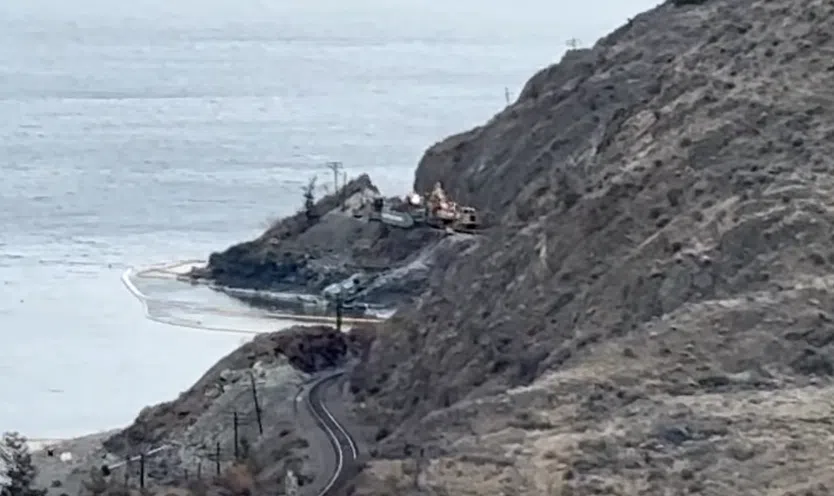
Photo from Mike Grenier
Cleanup and water monitoring efforts are continuing this week following last weekend’s derailment near Cherry Creek that spilled more than 80,000 litres of aviation fuel into Kamloops Lake.
According to Thompson-Nicola Regional District Area J Director Mike Grenier, environmental crews remain on site, and containment and cleanup work will continue through the weekend. “The work continues to remove aviation fuel from the shoreline area,” Grenier said. “The booms have been extended, and I can see this morning that there are multiple boats putting absorbent material into the water to soak up the fuel. CPKC tells me they’ll be scooping that material up, double-bagging it, and taking it to a qualified disposal site.”
Crews are also working to remove the damaged fuel cars and other rail cars involved in the derailment over the coming days.
Water Testing and Local Precautions
Water quality testing is ongoing at multiple intake locations around Kamloops Lake, including Savona, Tobiano, and Frederick.
Grenier said that while the Savona water intake remains open, Tobiano’s intake will stay closed for now as testing continues. Tobiano’s system is privately operated by Corix, which will make its own decision about when to reopen.
In Frederick, a small seasonal community on the lake’s south side, residents have been advised by Interior Health not to draw domestic water from the lake. “At the time of the derailment there was some wind activity, and modelling suggested it may have carried the fuel toward the Frederick side,” Grenier explained. “Interior Health has said not to take domestic supply out of the lake.”
Only a handful of residents remain in Frederick year-round, and CPKC is providing them with bottled and bulk water for domestic use while testing continues. “What’s important is that folks aren’t running their systems and potentially ingesting anything,” Grenier said.
Next Steps and Ongoing Oversight
Grenier said that while the initial test results have helped address some of the community’s water safety concerns, the scale of the spill has increased everyone’s vigilance. “The increased amount of fuel has created some anxiousness, which has been addressed by the water testing,” he said. “But that fuel has to go somewhere — it’s either on the shoreline or in the lake. I’m pleased to see that both provincial and federal agencies, including environment and transportation officials, are now involved. Everyone is taking on their responsibilities.”
He added that the TNRD will continue coordinating with partners and sharing updates as results come in. “The spill was in the ninth inning, and we want everything back to where it was in the eighth inning,” Grenier said. “We want a pristine environment, we want not to be worried about fuel on the shoreline or in the lake, and we want to see trains running smoothly through that area again.”