



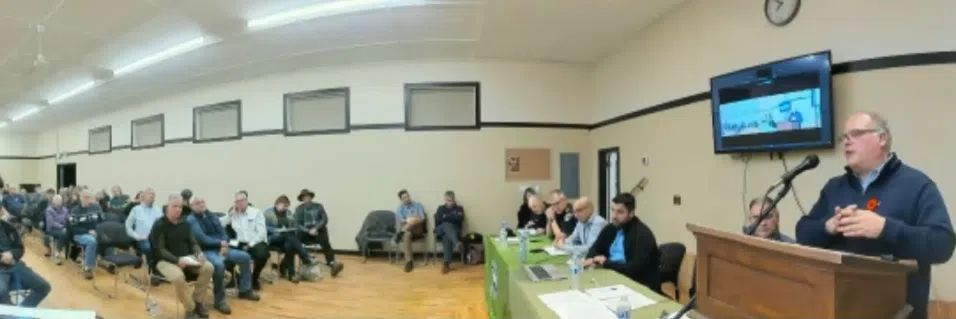
Frustration and unease echoed through a packed community meeting in Savona this week as residents, Indigenous leaders, and local officials demanded answers from Canadian Pacific Kansas City and government agencies following a major train derailment that spilled tens of thousands of litres of jet fuel into Kamloops Lake earlier this month.
The November 1 derailment — which saw a freight train leave the tracks near Cherry Creek, about 20 kilometres west of Kamloops — released some 70,000 litres of aviation fuel into the environment. While no injuries were reported and containment booms were deployed within hours, concerns over safety, environmental impact, and rail corridor maintenance remain top of mind for lakeside communities.
“Two derailments in four months”
During Monday’s meeting, Savona resident Shane Gottfriedson voiced what many locals have been thinking: “We’ve had two derailments in the last four months, both of them within a kilometre of each other. Both, from what I understand, possibly caused by a rock slide. My question is: what are you doing to inspect your tracks along these water corridors? Because it seems to be a recurring problem.”
CPKC spokesperson Mike LoVecchio said the company maintains “one of the most rigorous inspection programs in the rail industry.” “We inspect our tracks more frequently than required by regulation,” he said. “We use visual inspections, ultrasonic testing, and geometry cars that measure the track structure. In addition, we have rockslide detectors in areas prone to rock falls.”
LoVecchio noted the cause remains under investigation by the Transportation Safety Board of Canada (TSB) but emphasized that CPKC takes safety “very seriously.”
Monitoring for impacts on wildlife
Residents also pressed officials about the health of the lake’s ecosystem.
Dale Bull, Senior Response Officer with the B.C. Ministry of Environment and Parks, said ongoing field surveys and community observations have found no evidence of fish mortality linked to the spill. “Jet fuel is a lighter product that tends to evaporate and dissipate quickly, especially on a large body of water like Kamloops Lake,” Bull said. “However, we’ll continue to monitor closely.”
Private water users face uncertainty
CORRECTION: The only area with a current recommendation to use alternate water sources due to this incident is Frederick, due to previous reports from residents of fuel in the lake in this area, which were confirmed through the Ministry of Environment. When Interior Health receives confirmation that the remediation has been successfully completed, and sampling indicates there is no product in the surface water in the area – we will notify the residents of Frederick that our recommendation related to this spill is updated.
In general, Interior Health’s recommendation to any individuals using private water systems is to have disinfection in place for surface water sources and to get your water tested if you see any changes (odour, appearance or taste).
While Interior Health confirmed that public water systems in Tobiano and Savona show no contamination, residents with private lake intakes — especially in Frederick — remain under an advisory not to use their water.
Dr. Andy Delapizzi, Medical Health Officer with Interior Health, explained the jurisdictional limits: “The Drinking Water Protection Act gives us authority over public systems with more than one connection. For private intakes, we don’t have the same statutory control. Out of caution, we’ve advised residents not to use their water until we can confirm it’s safe.”
Mike Grenier, Area Director with the Thompson-Nicola Regional District, said testing is underway. “We’ve been working with CPKC’s environmental consultants to test deep-water intakes at Frederick,” he said. “We understand the anxiety this is causing, and we’re working to get definitive answers as quickly as possible.”
What is SCAT — and why it matters
One resident asked what “SCAT teams” were doing along the shoreline.
Bull explained that SCAT, or Shoreline Cleanup and Assessment Technique, is a standard process used during environmental spill response. “Teams made up of CPKC, government, and First Nations representatives walk the shoreline, document oiling, and record sensitive habitats or cultural features,” he said. “They use that data to determine the safest and most effective cleanup methods.”
Cleaning the shoreline — no chemicals involved
Another resident asked whether CPKC was using chemicals to clean contaminated rocks and beaches.
Kevin Houle, Environmental Lead for CPKC, clarified that no chemical dispersants are being used. “The primary method is shoreline flushing — using low-pressure, ambient-temperature water to rinse the affected areas,” he explained. “The water and fuel are then collected with booms and absorbent materials. It’s a gentle technique that avoids erosion or further disturbance to habitat.”
All recovered material, Houle added, is being properly disposed of at a licensed facility.
Explaining the “clean” water test results
Some residents expressed skepticism that, despite the spill’s size, water samples continue to show no contamination beyond the immediate site.
Bull said the findings are consistent with both modeling and observed behavior of Jet A1 fuel. “Kamloops Lake is a large, dynamic body of water with strong mixing and dilution,” he said. “Jet A1 is light and non-persistent — much of it evaporated quickly after the spill. What did enter the water spread as a thin surface sheen contained by booms. Sampling from various depths has shown no evidence of a plume moving through the water column.”
Chris Raymond, from Environment and Climate Change Canada, added that trajectory modeling and aerial surveillance confirmed the spill’s rapid dissipation.
Questions over compensation and transparency
Concerns over financial impacts were also raised by Dawn McGrath of the Skeetchestn Indian Band , who asked about compensation and data ownership. “What is the window for people to recover costs through your insurance claims? And who owns the water samples that are being taken?”
LoVecchio responded that there is no deadline for filing claims. “We encourage anyone who feels they’ve incurred costs as a result of this incident to submit a claim through our website or community connect line,” he said. “Each claim is assessed on its own merits.”
On the question of transparency, he added: “Water samples are collected by our environmental consultants, but the results are shared with all members of the Unified Command — including the provincial and federal governments and our First Nations partners. There is full transparency with the data.”
First Nations call for respect for traditional knowledge
Chief Cliff Drainey of the Shuswap Nation Tribal Council challenged some of the evening’s official statements. “I’ve heard a couple of times tonight that there’s been no loss of wildlife or fish mortality. I dispute that,” he said. “Our people have been on the land and on the water, and we have seen evidence of impacts. We’re documenting that, and we’ll share it with the Unified Command. Our traditional knowledge and our observations must be respected and included.”
His comments were met with nods from audience members and local officials alike, underscoring the importance of Indigenous participation in environmental assessment.
Who decides when the cleanup is finished?
One resident asked who makes the final call on when cleanup efforts end.
Bull explained that the decision will be made collaboratively within the Unified Command, which includes federal, provincial, and First Nations partners. “The cleanup isn’t considered complete until all members of the Unified Command — including our First Nations partners — agree that the cleanup endpoints have been met,” he said.
“If there’s disagreement, there are processes within the Unified Command structure to resolve it.”
He also reminded residents that anyone observing possible contamination can report it directly to the provincial spill reporting line at 1-800-663-3456.
Looking ahead
Containment booms remain in place near the derailment site. Environmental testing continues, with all samples to date showing results below provincial drinking-water guidelines.
Still, many in the room said that, while cleanup appears to be progressing, they want stronger prevention measures. “This isn’t the first derailment,” one attendee remarked as the meeting closed. “It can’t keep happening here.”