




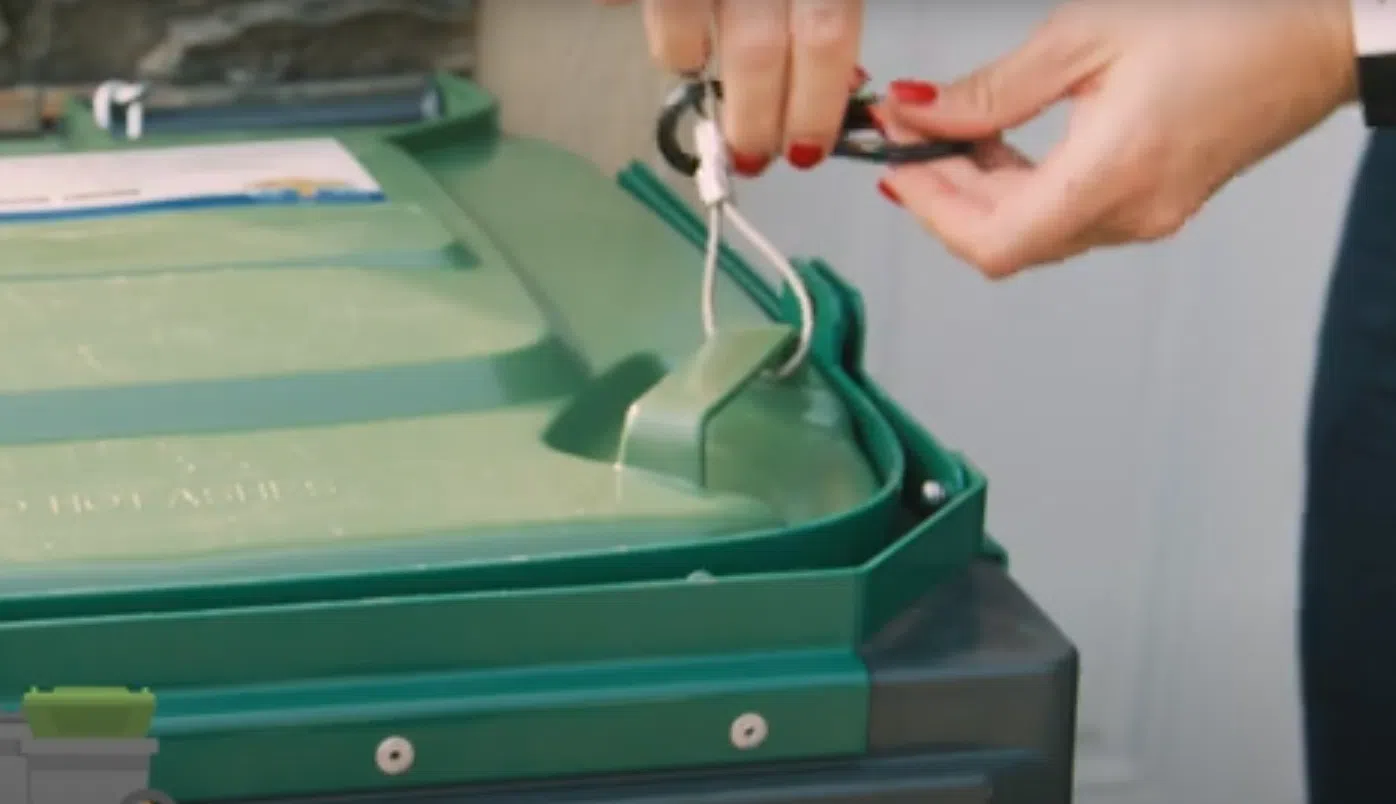
Kamloops’ move toward wider use of bear-resistant waste carts is showing steady progress, with city staff reporting more than 500 requests from residents since the program launched community-wide earlier this year. An update delivered to Council’s Livability and Sustainability Select Committee this week described the carts as a key tool in reducing human–bear conflicts and supporting the city’s BearSmart designation.
The City of Kamloops has been a designated BearSmart community since 2009, the first in B.C. to join the voluntary program. Its 2023 Human–Bear Conflict Management Plan emphasizes limiting wildlife attractants—particularly unsecured residential waste, which remains the number-one draw for bears in urban areas.
“Preventing food conditioning in bears is essential to prevent bears from being destroyed,” Environmental Services Supervisor Danielle Sparks told councillors. “Bear-resistant carts provide an option for residents who do not have access to secure storage such as garages or sheds.”
Pilot program success led to citywide rollout
Council first approved a pilot program in Juniper Ridge in 2022, using 120-litre bear-resistant organics carts with reinforced lids and external locking mechanisms. Over two years, the pilot examined usability, durability, and resident satisfaction through field monitoring and community surveys. Staff found the carts effectively prevented bears from accessing waste and were especially valuable for residents unable to store carts indoors.
In June 2024, Council approved a citywide rollout on an as-requested basis, adding a $20 per-cart annual lease fee to cover the more robust design.
Although ordering delays meant the carts did not arrive until July 2025, uptake has been steady. According to a staff memo, residents have so far ordered 545 carts—356 for organics and 189 for garbage in both 120-L and 245-L sizes.
Bear conflicts down, but monitoring continues
Sparks reported that human–bear conflict calls in 2025 are lower than in previous years, due largely to abundant natural food sources. The BC Conservation Officer Service’s most recent data also shows a downward trend: Kamloops saw 15 bears destroyed in 2023, four in 2024, and just two so far in 2025.
Councillors praised the positive trend. “There were 88 bears killed in Kamloops from 2015 to 2022,” Councillor Bepple noted, calling the recent decline “a step in the right direction.”
The city has documented two incidents this year where bears accessed cart contents after breaking carabiner clips. Staff replaced both damaged carts and are evaluating stronger stainless-steel clip options if the issue persists.
Residents citywide eligible, with minimal missed pickups
Councillor Middleton asked whether the carts are restricted to certain neighbourhoods. Sparks confirmed that the program is open to all Kamloops residents, with carts distributed on a first-come, first-served basis. Inventory is replenished as needed.
Missed waste pickups due to residents forgetting to unlatch carts have been “very minimal,” Sparks said, noting that education during the pilot helped clarify that residents—not city crews—must unlock carts before collection.
New wildlife attractant bylaw in development
The city is also preparing a new stand-alone wildlife attractant bylaw, which will give clearer guidance and stronger enforcement powers to address garbage, organics, and other attractants that draw wildlife into neighbourhoods.
According to the memo, city staff continue to participate in BearSmart working groups and convene the Human–Bear Conflict Management Committee. New cart designs, improved locking mechanisms, and alternative technologies will continue to be reviewed.
“As requests for bear-resistant carts continue, staff will monitor performance and evaluate emerging best practices,” the report states.