




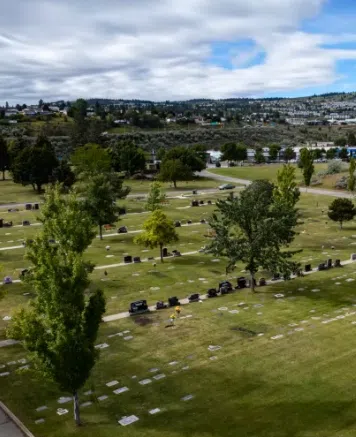
The City of Kamloops is taking a closer look at green burial as part of its long-term cemetery planning, with staff emphasizing that while no immediate changes are proposed, community interest is growing.
The discussion came before the Livability and Sustainability Select Committee on February 23, where Civic Operations Business Manager Glen Farrow presented a report outlining how green burial could fit into the City’s future plans.
“Today I’m talking about cemeteries — a new portfolio for me,” Farrow told the committee. “As I’m learning this whole new industry and operations, it’s been really exciting.”
Farrow was joined by Cemeteries Coordinator Alison Bratton and framed the presentation within Council’s broader priorities around governance, sustainability, and economic health.
“There’s strong ties to governance and service excellence, as well as livability and sustainability — obviously with the green environmental focus there — and then economic health, providing different opportunities and options for our citizens at our cemeteries,” he said.
Five Cemeteries, One Long-Term Vision
The City owns five cemeteries. Three — the Chinese Cemetery, the Pioneer Cemetery on Lorne Street, and the Provincial Home Cemetery on 6th Avenue — are historic and inactive. Two remain active: Pleasant Street Cemetery and Hillside Cemetery, with Hillside serving as the primary burial site.
Pleasant Street is largely sold out, though some burials continue in previously purchased plots. Hillside Cemetery, located on Notre Dame Drive, has significant remaining capacity and land available for future development.
Farrow noted that green burial was studied as far back as 2012, when a feasibility review concluded it could be implemented at Hillside, subject to technical analysis and regulatory approvals.
What Green Burial Would Look Like
Green burial — sometimes called natural burial — minimizes environmental impacts associated with conventional burial practices. It typically includes:
- No embalming chemicals such as formaldehyde
- Biodegradable shrouds or caskets
- No concrete vaults or grave liners
- Naturalized landscape restoration
- Simple or communal memorialization rather than individual headstones
“It’s the ability to do the process in a much more environmentally friendly way with a lot less products, material, chemicals,” Farrow said, adding that while requests are not frequent, “through the year there’s a few asks as people are looking for alternatives.”
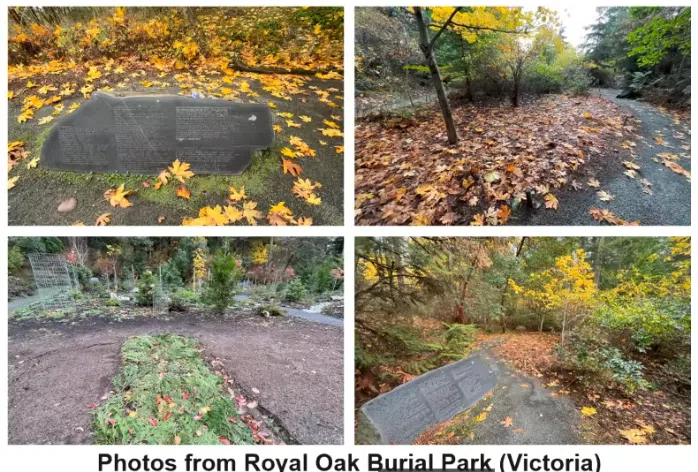
To better understand how such a section might function, City staff previously visited Royal Oak Burial Park in Victoria, which operates one of the province’s more established green burial areas.
“It’s a bit of a different environment — a lot greener, a lot more trees — but very natural and a fairly large area,” Farrow said. “Very different than your typical cemetery that we have.”
Measuring Demand
During committee discussion, Councillor Nancy Bepple pointed to growing interest provincewide.
“When I googled, there’s 17 cemeteries in B.C. that have some form of green burial,” Bepple said. At Royal Oak, she noted, “they sell up to 50 plots a year … so there’s a huge demand in that location.”
Bepple also cited figures from the National Funeral Directors Association suggesting roughly 60 per cent of people are interested in exploring green funeral options.
“We have the highest cremation rates in the country here in B.C.,” she said. “But if that was an option, it might be something that was taken up.”
While the staff memo outlined potential operational and environmental benefits — including reduced use of concrete and chemicals and possibly lower long-term maintenance costs — Bepple argued the most important benefit is service to families.
“I think the very highest benefit is that we provide a service that people want,” she said. “Just as people want a mausoleum, or they want a cremation, or they want some other way of showing respect and dignity at the end of someone’s life.”
She added that offering green burial would reflect Council’s role in responding to evolving community values. “This is definitely not just an operational issue — it’s what is it that the community wants.”
Operational and Environmental Questions
Farrow emphasized that while green burial is not new in B.C., it would be new to Kamloops.
Staff would require additional training, and regulatory approvals and bylaw amendments would likely be necessary. Public education would also be important to set expectations around appearance and memorialization.
Site suitability is another key consideration. Portions of Hillside Cemetery include varied slopes and drainage patterns, as well as nearby water infrastructure.
“We’d have to look at where appropriate drainage would be,” Farrow said. “There is some water infrastructure there with a reservoir — if that were to overflow, where would that go? There are overland flood routes in place at the current site, so we’d have to look into all these things.”
Uncertainty about long-term demand is also a factor. “We wouldn’t want to set aside too significant of an area that would just sit,” he said, noting that further research would be required to gauge uptake rates.
Cemetery Capacity and the Long View
Committee members also asked about the long-term lifespan of the City’s cemetery system.
Farrow explained that capacity varies by burial type. Some offerings — such as certain columbarium niches and vertical headstone sections — are already at capacity. Crypts within the mausoleum, however, still have room.
“At this point, there’s a lot of capacity within Hillside and a lot of acres for future development,” he said, though future needs will depend on death rates and burial preferences.
One councillor raised the broader planning question: if green burial significantly increases demand for space, could it accelerate the need for additional cemetery land?
“How do we look at that so that 20 years from now we don’t have a big ‘oops’ and no plan forward?” the councillor asked.
No Immediate Decision
For now, green burial remains a conceptual option within long-term planning. No direction was requested from committee, though Councillor Bepple indicated he may consider bringing forward a notice of motion so full Council can weigh in.
“I think we should be getting ourselves organized,” he said. “If this is something that the community wants, we should be prepared for it.”
Staff will continue reviewing cemetery planning needs and report back to Council as appropriate.