



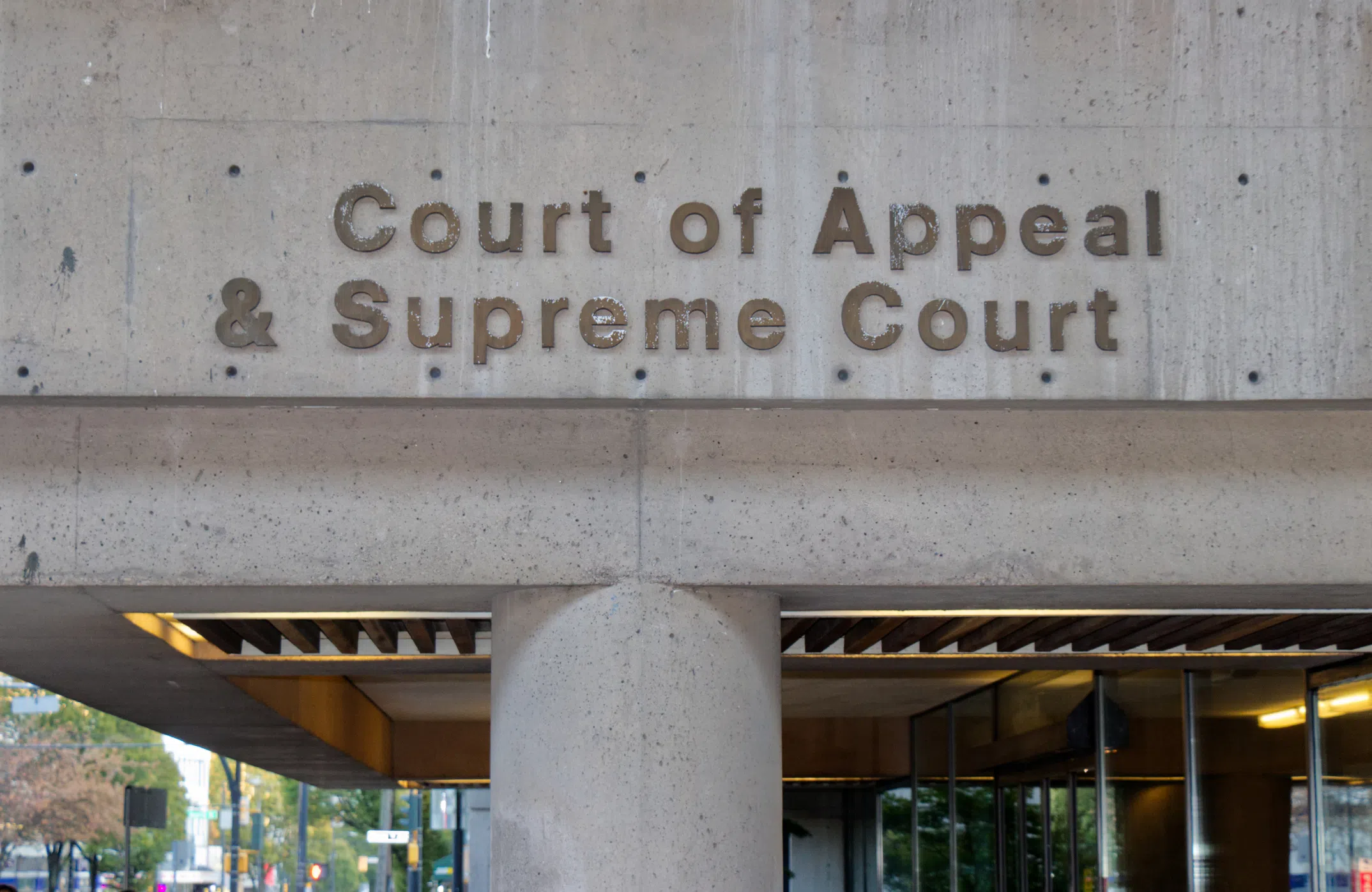
Vancouver, Canada - October 5, 2019: Sign of Court of Appeal and Supreme Court in Downtown Vancouver
A North Kamloops property where two skulls were uncovered last summer has become more than a local land dispute — it has become a case study, according to one lawyer, in how British Columbia’s legal landscape has shifted dramatically toward Indigenous claims, with little room for landowners to challenge outcomes.
Christine Elliott, a commercial real estate lawyer with 40 years of experience in B.C., says what her client has encountered is not just an archaeological issue — it is a structural legal shift.
“We used to have one version of legal title in this province,” Elliott said. “The Torrens system. You look at the Land Title Office, you know who owns what. Now we have two systems running alongside each other — private land ownership and First Nations claims — and they are in collision.”
From science-based to designation-based
When the skulls were discovered, the property was quickly registered as an archaeological site under the Heritage Conservation Act. The local First Nation declared it a sacred site the same day.
Elliott retained archaeologist Gordon Mohs, whose preliminary field reconnaissance found:
- No visible archaeological features
- No fire-altered rock, pit houses, roasting pits or artifacts
- No proximity to potable water typically associated with settlement sites
- A 1–1.5 metre sandy layer appearing to be imported fill containing concrete and construction debris
Mohs concluded the remains were likely contained within imported sand fill.
But Elliott says the Archaeology Branch advised that origin does not matter. “It doesn’t matter how the material arrived on the land,” she said. “If ancient remains are present, that’s it. It’s a heritage site and that’s the end of it.”
For Elliott, that marks a shift. “In the past, archaeology was a scientific endeavor. You looked for evidence — charcoal, burned rock, structural depressions. Now we appear to have moved to a model where cultural designation is sufficient.”
No meaningful avenue to challenge
Elliott says what troubles her most is not the cultural recognition of ancestral remains — but the lack of procedural mechanisms available to landowners.
“There is zero way through,” she said. “No appeal mechanism. No compensation mechanism. No transparent evidentiary standard that a landowner can test.”
Under the Heritage Conservation Act, unauthorized alteration of a site can carry penalties of:
- Up to $1 million per day for corporations
- Up to $50,000 per day for individuals
“You are effectively frozen,” she said. “The penalties are so severe you cannot risk moving.”
Elliott described recent communications with provincial officials as “Kafkaesque,” saying her client was asked to respond to unspecified concerns without knowing the nature of any formal complaint or if there was a complaint and if so, who made it.
“You’re responding without being told what you’re responding to,” she said.
DRIPA and the broader shift
While the immediate designation arises under the Heritage Conservation Act, Elliott says the broader legal climate has shifted significantly since the province adopted the Declaration on the Rights of Indigenous Peoples Act in 2019.
She characterizes the past three decades of B.C. case law as a “rising tide” expanding Indigenous rights recognition, with DRIPA formalizing alignment with UNDRIP principles.
“The upper hand at the moment is clear,” she said. “If there is a collision between private land use and an Indigenous claim of significance, there is very little room to push back.”
She says this creates uncertainty not just for individual landowners, but for municipalities and infrastructure planning.
Elliott says she supports that move.
“It’s not just about one property,” she said. The site boundary on the Kamloops property claims a 50m boundary outside the property itself. This covers two adjacent roads. “You are potentially talking about roads, services, tax base.”
Transparency concerns
Elliott also raised concerns about access to the province’s Remote Access to Archaeological Data (RAAD) system.
While parcel-specific searches are possible, broader geographic context is not publicly accessible.
“Context is everything,” she said. “With environmental issues, I can look at historical uses on and around a property. I am not going in blind. Here, I am.”
Even so, she acknowledges that in this case no archaeological filing existed when her client purchased the property in 2004.
“So I couldn’t have saved my client,” she said.
A system functioning as intended?
Elliott says the key legal question is whether the current framework is working as designed.
“If the intent is to deprive an owner of 100% of the benefit without compensation,” she said, “then it is functioning as intended.”
She says the deeper issue is not cultural respect, but legal balance.
“How do you reconcile two systems that both claim authority over land use?” she asked. “Right now, there is no short-order solution.”
The lot remains fenced and unused.
And Elliott believes this case is a preview of similar conflicts as Indigenous land claims,
heritage protections and private property law and road/local government infrastructure continue to intersect in British Columbia. Elliott knows of one other property in the Interior with similar issues. She expects this number to increase.
“This isn’t going anywhere fast,” she said. “And I don’t think this is the last time we’ll see it.”
Lessons from Lytton
Lytton, being rebuilt almost entirely after a catastrophic wildfire, highlighted how archaeological requirements under the Heritage Conservation Act have delayed reconstruction, increased costs, and created uncertainty for residents and local governments.
The Village urged the Ministry to expedite permitting for disaster-affected communities, clarify timelines and criteria for consent-based agreements under DRIPA, and consider a “Chance Find” procedure with local monitors to alleviate costs and delays.
Mayor Denise O’Connor stressed that while heritage protection and reconciliation remain priorities, legislative reforms should not create additional obstacles to rebuilding and community recovery.