




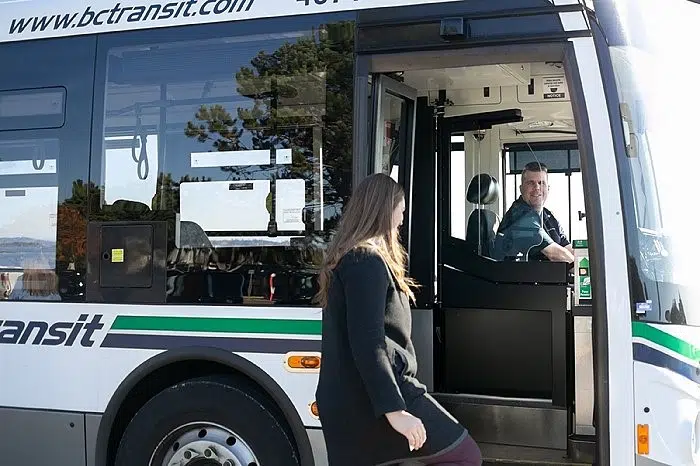
Kamloops transit riders will see fare increases arrive sooner than originally planned after city council voted Tuesday to accelerate future transit hikes amid growing ridership and ongoing service pressures.
Council approved a revised fare structure for the BC Transit system that will move previously approved 2027 fare increases ahead to September 2026, while also advancing planned 2029 increases into 2028.
The decision came following an extensive debate over transit affordability, fare evasion, service reliability and future transit expansion needs in Kamloops.
Ridership continues climbing
Transportation Planner Michael Lu told council the local transit system continues performing strongly despite operational challenges.
Kamloops recorded 3.7 million transit trips during the latest fiscal year, up from 3.62 million the year before and now sitting roughly 15% to 20% above pre-pandemic ridership levels.
The city also generated approximately $4.6 million in transit revenue during the fiscal year and ranks among the top-performing comparable transit systems in British Columbia for cost recovery.
Council heard the transit system currently recovers roughly 28% of its total operating costs directly through fares, though staff noted the province also covers nearly 47% of conventional transit operating costs through BC Transit funding.
The 2025 Customer Satisfaction Report surveyed 640 Kamloops riders and found most people use transit for work, errands and shopping, while affordability and convenience remain the primary reasons residents continue taking the bus.
Riders raise concerns over delays, cleanliness and fare evasion
Despite strong ridership numbers, concerns over late buses, cleanliness, connections and fare evasion generated significant discussion at council.
Several councillors raised complaints from seniors and other riders frustrated by passengers boarding buses without paying.
Lu said operators are instructed not to intervene directly because of safety concerns, noting drivers risk being assaulted if confrontations escalate.
BC Transit Government Relations Manager Danica White said the transit authority is currently studying fare evasion through a pilot project in Victoria.
The study is examining how much fare loss stems from deliberate non-payment versus riders using incorrect fare products, particularly following the rollout of electronic fare systems such as Umo.
Mayor Reid Hamer-Jackson questioned whether more proactive enforcement measures may eventually be needed, comparing fare evasion to shoplifting.
Council also discussed complaints regarding cleanliness onboard buses.
White said Transdev continues meeting or exceeding BC Transit cleanliness standards, though she acknowledged public perception of cleanliness could still be improved.
Construction projects impacting reliability
Council heard transit reliability has also been affected by major road construction projects across Kamloops.
BC Transit defines an “on-time” bus as arriving no more than one minute early or three minutes late. Kamloops’ on-time performance sat between 55% and 60% through much of 2025 due largely to projects including Tranquille Road upgrades, Columbia Street repaving and Overlanders Bridge work.
Staff said recent service expansions have since improved performance substantially, with recent on-time numbers reaching nearly 78%.
Councillors also discussed challenges associated with adjusting schedules quickly enough during long-term construction projects, with staff noting BC Transit scheduling is often finalized months in advance.
Expansion plans denied by province
Meanwhile, Kamloops learned it will not receive provincial funding for a proposed 2026-27 transit expansion package because of provincial budget constraints.
The rejected proposal included expanded airport service, Org Road service and increased frequencies on several existing routes.
Councillor Stephen Karpuk warned the province cannot continue demanding housing growth without also funding expanded transit services.
The city also confirmed Kamloops is expected to receive 10 new battery-electric buses later this fall.
Council split on accelerating fare hikes
Debate over future transit fares divided council.
Councillor Kelly Hall argued council should stick with the original phased-in fare structure it had already approved previously.
However, Councillor Margot Middleton successfully introduced an amendment to move both planned fare increases ahead by one year.
Under the approved structure, fare increases originally scheduled for 2027 will now take effect in September 2026, while the 2029 increases will now arrive in 2028.