



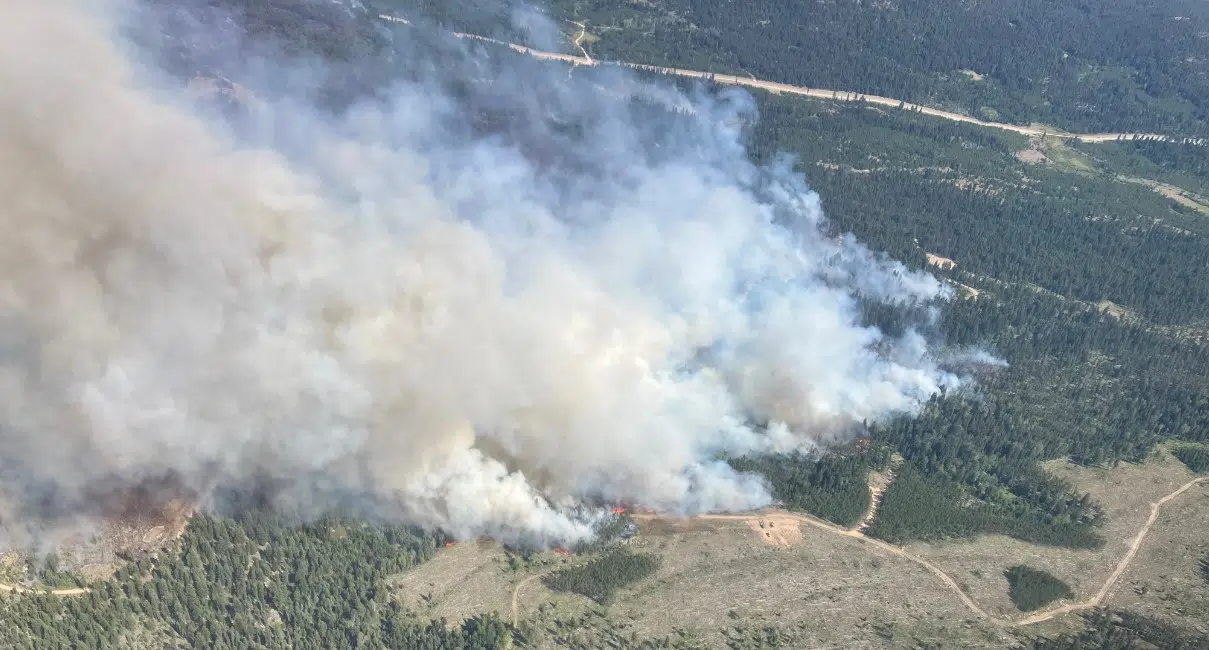
Smoke from the flare-up of the Ross Moore Lake fire on Saturday, which rolled over Kamloops through the afternoon/Via BC Wildfire Service
The BC Wildfire Service is expecting all three fires in the Adams Complex near Kamloops to grow in size over the next few days.
Information Officer, Forrest Tower says those fires include Ross Moore Lake, the Lower East Adams Lake, and Bush Creek East fires.
He says the expected growth is due to the warm and dry conditions in the forecast.
“But with the operations that we’ve had in place, we’ve been able to keep fires where they are,” Tower told Radio NL. “We still will see some growth in areas where it is more trees that are burning and producing smoke but not threatening any highway corridors or structures.”
The Ross Moore Lake Fire is currently estimated to be 41.5 square kilometres in size. Most of the increased fire activity is expected to be along the west and south flanks of the fire, though Tower says there continues to be no danger to the City of Kamloops or Lac Le Jeune Provincial Park.
There are still 18 TNRD properties within the fire zone that remain on evacuation order, while around 300 others remain on alert.
The Lower East Adams Lake fire is currently mapped at 27 square kilometres while the Bush Creek East Fire is about 10 square kilometres in size.
Tuesday afternoon, the Columbia-Shuswap Regional District and the Adams Lake Indian Band rescinded some evacuation alerts near the Lower East Adams Lake fire. It comes after the BC Wildfire Service moved out its structural protection crews from the area on Monday citing a diminished risk for the properties.
That fire continues burning on the north and west flanks away from the properties in the area.
As for the Bush Creek East fire, while it has grown a bit on the west flank, it is not posing any threat to this travel route or the roughly dozen properties that are on alert.
“With the incoming resources that we’ve had this last week, we do have an increased amount of ground resources on these fires that will just be working day in and day out to kind of control lines,” Tower added.
“They’ll just be – as always with firefighting – moving from those fixed anchor points trying to wrap in and keep it contained.”