




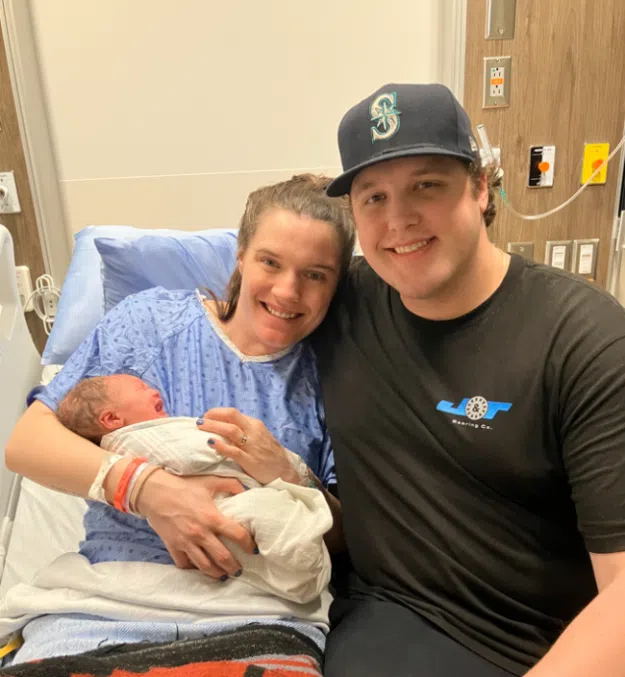
Baby boy Emerson, born 12:02am, Jan. 1, 2025 at Royal Inland Hospital with parents Jordan and Elijah/via Interior Health
Defying the less than 4% odds — according to the BC Lottery Corporation — BC’s first born of 2025 was delivered in Kamloops.
The BC Government confirmed that a boy was born at 12:02am on January 1, 2025 at Royal Inland Hospital.
Emerson was 7lbs 10oz, and is the first child of Jordan and Elijah Hill.
In the lead up to Emerson’s birth, Playnow.com had Royal Inland Hospital at 26:1 odds of being the first hospital to see a child delivered to start out the calendar year.
Emerson’s name gets an early start on the competition for 2025’s top baby name of the year, which saw Oliver emerge as the most popular through 2024.
According to BC Vital Statistics, there were 216 boys were named Oliver in BC last year, followed by 166 who are known as Liam, and 163 kids who will answer to Noah.
The 2024 top ranked name for girls went to Olivia at 172, followed by 146 named Charlotte and 135 girls who now go by Ilsa.
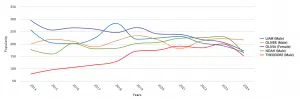
Graph showing popularity of BC baby names/via BC Vital Statistics
Not only will Emerson be getting a ‘welcome basket’ from the Kamloops Chamber of Commerce, Emerson’s parents Jordan and Elijah can also claim — if they choose — to have their child known as the first born in British Columbia to the so-called “Beta Generation.”
This is the non-official term being promoted by those on the Internet and elsewhere as the label children born between 2025 and 2039 are now going be saddled with.
They take over — according to the chronology — from the “Alpha Generation,” who, according to the theory, were born born between 2010 and 2024.
Before them it’s the current generation of young adults who are known as “Gen Z” (1995-2009).
All of this construct is based around a theory put together in a book by a pair of American writers, not long after BC-raised author Douglas Coupland used the term “Generation X” to title a book he put out in 1991 to describe the 3rd generation of children who emerged following the end of World War II.
The American authors Neil Howe and William Strauss theorized that generational swings take place in the United States every 21 years.
The 21 year figure is derived by dividing 84 — the average American life span in 1991 — by the number of different ‘generational’ moments a US citizen would live through in their lifetime.
This theory has widely been criticized as “psudeoscience” based on a US-centric philosophy.