



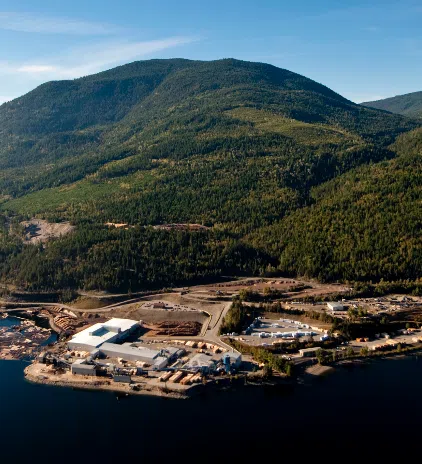
Photo via interfor.com
A two‑week curtailment at Interfor’s Adams Lake sawmill, announced late Friday, threatens the livelihoods of roughly 400 families in the region, according to Ward Stamer, BC Conservative Forest Critic and MLA for Kamloops‑North Thompson.
In an interview with Radio NL, Stamer warned that this latest shutdown is symptomatic of deeper troubles in B.C.’s forestry sector, pointing to rising costs, U.S. tariffs, and regulatory delays as key drivers of the crisis.
“This is exactly what we were afraid would happen,” said Stamer. “Grand Forks was the first domino to fall a couple of weeks ago, and now it’s Adams Lake. It’s devastating.”
Economic Strain on Local Families
Workers, contractors, and support staff at the mill will face at least two weeks without income. Stamer emphasized that these are local families integral to the social and economic fabric of the North Thompson Valley.
Compounding the issue: many affected workers will not qualify for Employment Insurance during the shutdown, owing to mandatory waiting periods.
“There’s a two‑week waiting period before you can even collect,” Stamer said. “These families are basically left dangling.”
Tariff Pressures and Production Costs
Stamer said that the combination of expensive raw logs and a 10% U.S. softwood lumber tariff has pushed margins to the breaking point. The tariff, he noted, was a major factor in the indefinite curtailment at Interfor’s Grand Forks operation—and is now biting into Adams Lake’s viability. “It’s just too expensive,” Stamer told reporters. “That extra 10% tariff was the nail in the coffin in Grand Forks. The same pressures are building here.”
Interfor has announced it will scale back production by some 26% company‑wide, with Interfor warning of the potential for further curtailments in the weeks ahead.
“These curtailments are expected to reduce lumber production in the fourth quarter of 2025 by approximately 250 million board feet, or 26%, as compared to the second quarter of 2025, which reflected a more normal operating stance,” said Interfor in a statement on Friday.
“The curtailment volumes are approximately evenly split between Interfor’s Canadian and U.S. operations,” the Burnaby-based company added.
Interfor does caution that this might not be the last of the hardships of their employees and the company itself.
“Lumber prices in all regions of North America have continued to weaken, from already unsustainably low levels,” said Ian Fillinger, Interfor’s President & CEO in the Friday release.
“Our revised operating plans for the fourth quarter reflect our disciplined approach to match production levels with reduced market demand. While necessary, we fully recognize the impact these actions will have on our employees, contractors, suppliers and communities.”
Interfor goes on to say that it will “continue to monitor market conditions across all of its operations” and adjust its production plans accordingly.
Stamer Presses for Government Intervention
Stamer, set to meet with B.C.’s Minister of Forests next week, urged both the provincial and federal governments to act swiftly to stabilize the region’s forestry economy.
“We’ve talked about stumpage rates, supply issues, permitting problems. There haven’t been any wholesale changes from the ministry,” he said. “We need action now — the dominoes are falling.”
Though federal loans via the Business Development Bank of Canada are sometimes floated as a tool, Stamer argued they are ill-suited for the present crisis. “Those loans are meant for modernizing manufacturing, not for saving jobs or helping workers get through a curtailment,” he said.
Permitting Delays Exacerbate the Problem
Stamer also raised concerns about permitting bottlenecks affecting private landowners in the North Thompson Valley.
Because of a strike in the permitting system by the public sector unions, some landowners cannot obtain what’s known as a “timber mark,” which allows the legal transfer or sale of logs—even if the timber is on their own property.
“You can’t sell logs off your own land without a timber mark,” Stamer explained. “They can’t get the mark because of the strike. The forest minister does have the authority to resolve this — so I’ll be pushing for that in our meeting today.”
A Call for Coordinated Industry Support
Stamer emphasized that the forestry industry requires the same urgency and coordinated response as other major sectors such as energy, mining, and manufacturing. “This is just as serious as what’s happening in the auto industry, or energy, or mining,” he said. “If Ottawa won’t push back on tariffs, then we need other tools. Right now, we’re just pointing fingers while communities suffer.”