




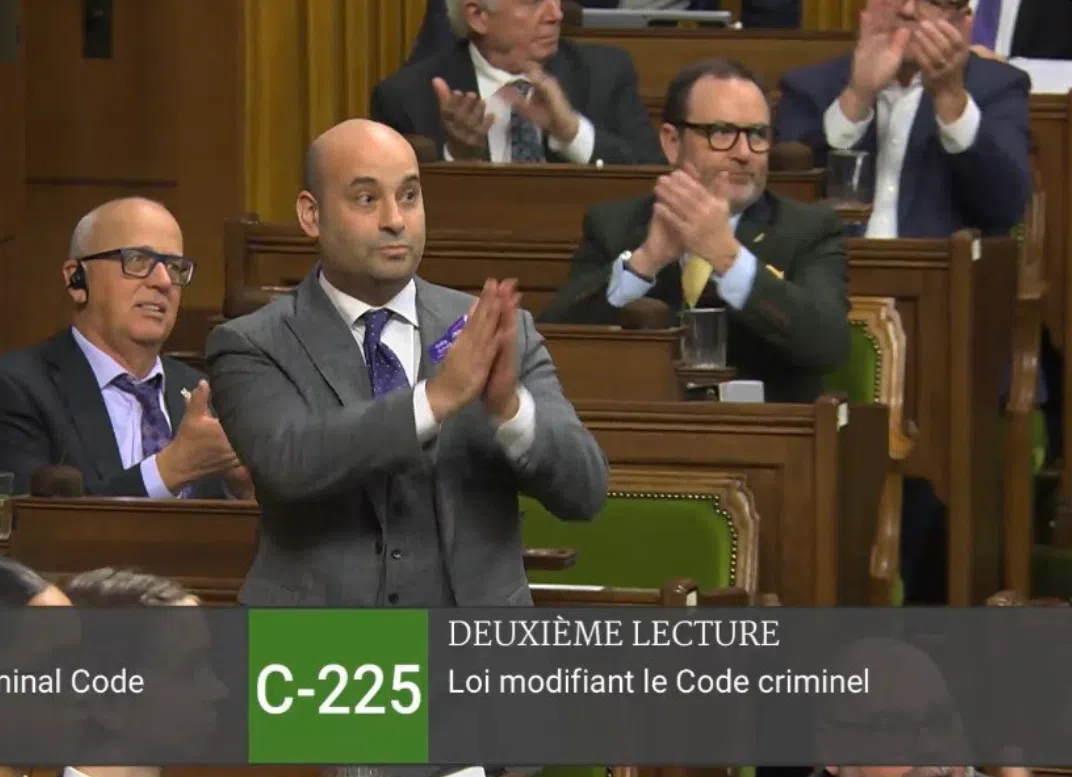
Bill C-225 passed second reading this week with backing from all parties, an uncommon show of unity for any private member’s bill. The legislation — introduced by Caputo, who also serves as the Conservative Shadow Minister for Public Safety — seeks to overhaul how the justice system handles intimate partner violence, including by creating new offences and elevating the murder of an intimate partner to first-degree murder.
In an interview with Radio NL, Caputo said the emotion of the moment is still settling in. “It still hasn’t quite set in yet,” Caputo said. “It was a pretty emotional time. There were members of Bailey’s family there, and the whole House — all parties — turned towards them and gave a standing ovation. I’d never seen anything like that before on a private member’s bill or a bill period.”
He said even MPs with more than a decade of parliamentary experience told him they’d never witnessed such a show of unity. “Very emotional… It was touch and go for a bit there. I’m just overjoyed that we’ve cleared one of the bigger hurdles, but there’s still a lot of work to be done.”
A bill born from tragedy
Bailey’s Law is named for 25-year-old Kelowna mother, Bailey McCourt, who was killed on July 4, 2025 — just hours after her former intimate partner, James Plover, was allowed out on bail while awaiting sentencing on separate assault case. He is then alleged to have attacked his estranged wife, Bailey McCourt. Just recently, the Crown upgraded Plover’s charge to first-degree murder, along with dangerous operation of a motor vehicle causing bodily harm.
The attack that killed McCourt — described by RCMP as a “highly visible and tragic” hit-and-run and assault with a weapon — also left another woman, Carrie, with serious injuries. She survived and was later released from hospital.
The case has sparked widespread calls across B.C. for stronger bail rules and more robust legal protections for victims of intimate partner violence.
Caputo said the advocacy of McCourt’s family directly shaped the bill. “I want to thank Bailey’s family… for their tireless advocacy pushing these major changes,” he said. “And I want to thank Carrie, who suffered in the attack that took Bailey’s life.”
What Bailey’s Law would do
Caputo describes the bill as one of the most significant reforms to intimate partner violence law in Canadian history. “Bailey’s Law would create the new offences of assaulting an intimate partner, criminal harassment of an intimate partner… because doing this to an intimate partner is very different than punching someone at a bar,” he said.
“The relationship is one of trust, one of financial dependence, one where things happen behind closed doors.”
Key reforms include:
-
Automatically deeming the murder of an intimate partner to be first-degree murder.
-
Requiring anyone arrested for intimate partner violence who has a prior conviction within five years to be brought before a judge — instead of being released by police at the scene.
“It ramps up the seriousness… it shows the system means business when you’ve done this before,” Caputo said. “And that first-degree murder provision — that was called for by NDP Premier David Eby. These are eminently reasonable measures.”
Next steps — and concerns over delays
The bill now moves to the House Justice Committee for further study. Caputo said collaboration across party lines has been strong, and amendments are expected. “We’ve had very collaborative discussions… I’ve been in frequent contact with the Minister of Justice,” he said. “There will be amendments, and I have a good idea where they’ll go.”
But Caputo expressed frustration after Thursday’s Justice Committee meeting was cancelled. “I was really disappointed today — the Liberal Chair cancelled Justice Committee. We could have dealt with Bailey’s Law today,” he said. “That was a missed opportunity.”
He fears the bill could be pushed into March or April if meetings do not resume promptly. “I’m hoping for early January at the latest.”
As the Plover case resurfaces, calls for reform grow louder
Caputo acknowledged the timing of his bill’s progress coincides with renewed attention on the Plover case. Last week, Plover was sentenced to 12 months in jail for the earlier assault-by-strangling and uttering-threats charges — offences that a judge said caused “profound psychological and emotional impact” on the victims. With credit for time served, he has 147 days left in custody.
But Caputo cautions that Bailey’s Law isn’t about any single incident — it’s about addressing systemic gaps that have left thousands at risk. “We need to react as parliamentarians with the appropriate urgency,” he said.
“This isn’t just about Bailey’s case. It’s about every single person who has been victimized by intimate partner violence — and those who will be.”
He said the Plover case highlights how urgently governments must act, not because of the headlines but because intimate partners remain the most likely victims of violence. “It’s not about one case coinciding with another,” he said. “It’s about acting when we should have acted years ago. My hope is that we prevent thousands of others, or at least deal with them appropriately.”
Despite the challenges ahead in committee, Caputo said he remains optimistic. “Bill C-225 marks an important step toward reforming our criminal justice system,” he said.
“Its passage will help confront and ultimately reduce the scourge of intimate partner violence in Canada.”
Below is the reading of the vote count after which Caputo erupts with applause and celebration.