





In a somewhat surprising turn of events, the City of Kamloops is setting a national benchmark for employment.
New figures released Friday by Statistics Canada show the unemployment rate in the Kamloops Census Metropolitan Region plummeted to 3.8% in February.
This is a sharp decline from the 4.8% jobless rate registered in Kamloops for January, and is a stark departure from the 7.4% unemployment rate Kamloops carried with it through December and into 2026.
“A lot happening in Kamloops,” BC Jobs Minister Ravi Kahlon told Radio NL a few hours after Statistics Canada released its latest analysis of its Labour Force Survey.
“You’ve seen some of the work happening with the [Highland Valley Copper] Mine expansion,” added Kahlon when asked what he feels has been the driving force behind the dramatic uptick in employment in the Kamloops area.

Highland Valley Copper Mine near Logan Lake/via Brett Mineer
The start of a hiring blitz for the extension program has Teck Resources — soon to be officially known as AngloTeck once its merger with Anglo American is complete — will see around 1,000 new jobs added to the mine site over the coming year, which adds to the over 1,300 people already employed on a permanent basis at the mine near Logan Lake.
“The numbers are good,” added Kahlon. “The highlight: 3.8%, one of the lowest unemployment rates in the country — not only in British Columbia. That’s a promising sign.”
Of the cities listed as part of Stats Canada’s monthly review of its Labour Force Surveys, Kamloops would finish February with the 3rd lowest unemployment rate across the country — sharing a 3.8% unemployment rate with Trois-Rivières, QC.
That figure is surpassed only by Quebec City at 2.7% and Saguenay, QC, at 3.6%.
The jobless rate in Kamloops comes in as the lowest among the seven census metropolitan regions Stats Can reviews in BC each month, outpacing even Victoria, which saw its unemployment figure for February rise by 0.1% to 4.5% for the month.
Victoria’s large civil service tied to the provincial government generally means Victoria boasts the lowest unemployment rate in British Columbia, per-capita, each month.
The same analysis for February shows Nanaimo, which has a comparatively similar population and economic structure to that of Kamloops, saw its unemployment rate jump from 6.6% in January to 7.7% last month.
In the Interior, Kelowna’s jobless figures did decline, dropping half a percent last month from 6.8% in January down to 6.3% for February.
Kahlon also suggests that the diversified economy in Kamloops is helping the city weather some of the current economic headwinds brought on by the tariffs being levied by the Trump administration, in addition to the new level of uncertainty created through the conflict with Iran, which may begin to impact the Labour Force figures when the March analysis is revealed next month.
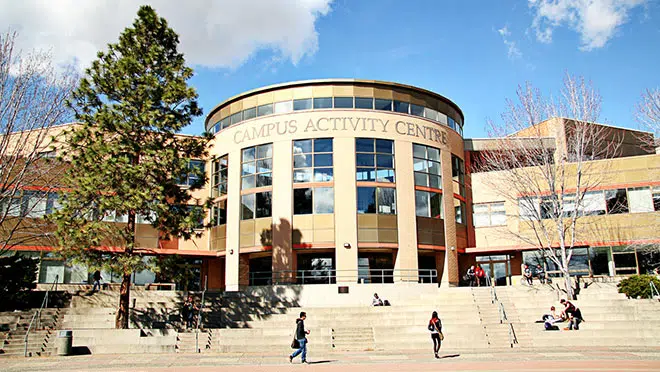
Campus Activity Centre at Thompson Rivers University/via TRU
“You’ve got a significant expansion of health care, which brings health care professionals. You’ve got the [Thompson Rivers] University there that’s obviously a major contributor to the local economy,” noted Kahlon in his conversation with Radio NL. “And, of course, the Tournament Capital [brand]. You’ve got the tourism piece. The golf courses are top-notch.”
But in saying that he remains ‘bullish’ about BC’s economic future, Kahlon does admit the current conflict in the Middle East, on top of the ongoing tariff dispute and the forthcoming review of the Canada-US-Mexico agreement on trade (CUSMA) does leave a lot of open questions about the broader health of the BC economy moving forward.
Kahlon points to the national unemployment figures, which saw employers shed some 84,000 jobs across Canada last month, pushing the national unemployment rate from 6.5% to 6.7%.
At the same time, the latest figures from the US Bureau of Labor Statistics showed the overall unemployment rate in the United States stayed steady at 4.4% through February, but did see its non-farm payroll stats — the key figure economists look for in gauging the overall health of the US economy — decline by 92,000 jobs last month.
That’s in stark comparison to the 126,000 similar jobs added to the payrolls in January.
“It’s creating a lot of uncertainty, and its not just in BC… this is North America wide,” lamented Kahlon. “If you look at the numbers that came out of the US around unemployment, and you look at what’s happening across the country [Canada], you can’t separate the two. The two are inter-connected.”
“Every time I see numbers like this — North America-wide numbers — I remind myself and I get frustrated that all this stuff around tariffs has actually had a downward impact on the US economy as well as the Canadian economy,” added Kahlon.
“I shake my head wondering why we’re in this situation that we’re in now.”
-

- Activities at the Tournament Capital Centre/via Tourism Kamloops
-

- Then-Health Minister Adrian Dix announcing plans for new Kamloops Cancer Care Centre/via Abby Zieverink
-

- GreenTee Country Club/via Tobiano
-

- Rivershore Golf Links/via Golf Kamloops
-

- The Phil and Jennie Gaglardi Tower/via Abby Zieverink
-

- Tourism Kamloops promotional picture/via Tourism Kamloops