




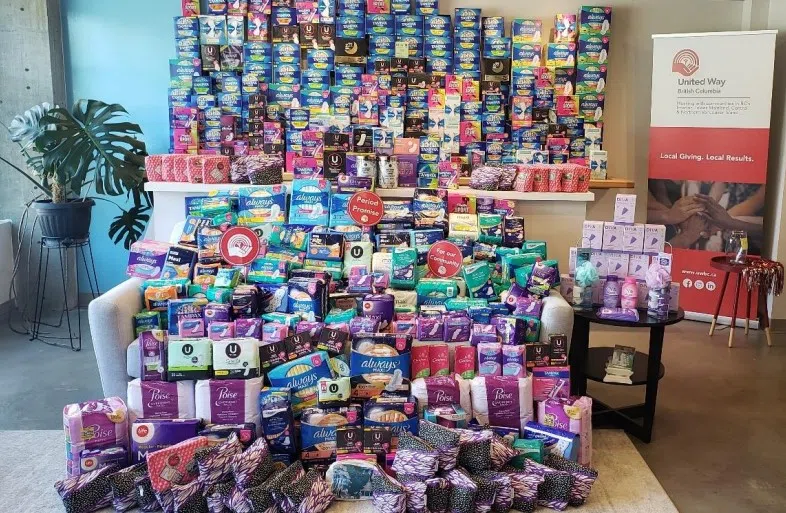
British Columbians are being urged to support a growing need for menstrual products as United Way BC kicks off its annual Period Promise campaign this May.
Running from May 1 to May 30, the campaign—presented by Pacific Blue Cross in partnership with CUPE Local 1816—aims to tackle period poverty across the province. This year, the need is more urgent than ever, with more than 2.3 million period products requested by over 120 community organizations, including food banks, schools, shelters, and health clinics.
Kristie Rintoul, Senior Director with United Way BC’s Community Impact and Investment portfolio, says the numbers reflect the harsh reality many people are facing amid rising living costs.
“Unfortunately, these products are expensive, and that’s a monthly cost that folks can’t go without,” Rintoul said. “When people have to choose between putting food on the table or accessing these products, they’re going to choose food—and that affects their ability to live life fully.”
A growing and often hidden crisis
United Way BC says menstrual supplies can cost between $80 and $100 per month, putting them out of reach for many households already stretched thin. The consequences go far beyond inconvenience.
Rintoul says people who lack access to period products may miss work or school, impacting their long-term stability.
“If you’re missing work consistently every month, the chances of you being able to sustain that work diminish,” she said. “It’s about dignity, confidence, and being able to participate in everyday life.”
Frontline organizations across the province report that some individuals resort to unsafe alternatives, while others—particularly those in rural or marginalized communities—are disproportionately affected.
More than donations
While donations are a key part of the campaign, Rintoul emphasizes that Period Promise is also about raising awareness and breaking stigma.
“This is why we call it the Period Promise campaign,” she said. “It’s about holding space for the conversation. Menstruation is still a taboo topic, and that can make it harder to address the need.”
That advocacy is already making an impact. In Kamloops, Thompson Rivers University and the City of Kamloops have introduced free menstrual products in public washrooms—an approach United Way BC supports as a long-term solution.
“We see this as a health essential, just like toilet paper,” Rintoul added.
Community effort in Kamloops
Locally, the campaign is gaining traction. Last year, more than 65,000 products were distributed in the Kamloops area, and organizers hope to meet or exceed that number in 2026.
Residents can contribute by donating menstrual products such as tampons, pads, or reusable items, or by making financial donations—matched dollar-for-dollar by Pacific Blue Cross up to $25,000.
Collection sites in Kamloops include the Delta Hotel’s Cordo restaurant and Sun Life Financial on 12th Street, with additional locations expected to be announced throughout the month.
Rintoul also acknowledged the role of local partners, including the Kruger Kamloops Pulp Mill, Unifor Local 10-B, and corporate donors like Procter & Gamble, for supporting storage and supply distribution.
How to help
United Way BC encourages individuals, workplaces, and community groups to host their own collection drives or donate online through the campaign website.
“Every contribution helps,” Rintoul said. “Whether it’s a product donation, a financial gift, or simply helping raise awareness, it all makes a difference for people who need it.”
As the campaign continues through May, organizers hope more British Columbians will step up—not just to meet immediate demand, but to help push for lasting change in how menstrual health is understood and supported.