




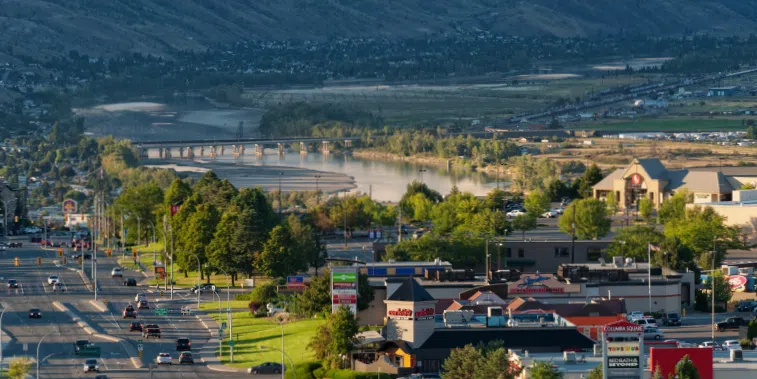
Aerial view of portion of downtown Kamloops/via City of Kamloops
The City of Kamloops says its most critical concrete water mains are expected to remain serviceable for decades after the completion of a major inspection program prompted by catastrophic pipe failures elsewhere in Canada.
Utilities Engineer Tyler Pahl briefed council on the city’s ongoing efforts to monitor and manage prestressed concrete cylinder pipe water mains — aging infrastructure that has drawn national attention following major ruptures in Calgary and Montreal in recent years.
“These pipes can fail catastrophically when their condition deteriorates,” Civic Operations Director Jen Fretz wrote in a May 5 memo to council outlining the city’s risk management strategy.
Kamloops has 23.5 kilometres of concrete pressure pipe installed between 1970 and 1983, accounting for roughly 3% of the city’s water mains. While relatively small in overall size, the mains are among the most important components of the water system, carrying large volumes of water through pipes ranging from 500 millimetres to 1,050 millimetres in diameter.
About 62% of the city’s concrete pressure pipe network has now been identified as the higher-risk prestressed concrete cylinder pipe, while the remainder is lower-risk bar-wrapped concrete cylinder pipe.
Prestressed concrete cylinder pipe became widely used across North America from the 1960s through the 1980s because it was economical for large water transmission systems. The pipe contains tightly wound high-strength steel wire around a concrete core. If those wires corrode or break, the stored tension can cause explosive failures.
Pahl told council that several high-profile ruptures in Calgary, Montreal, Nanaimo and Victoria prompted Kamloops to accelerate its inspection efforts.
“We’re often looking for needles in the haystack to see if there’s a failure in these systems,” he said.
Unlike cities in Eastern Canada, Kamloops faces lower corrosion risks because local roads are not heavily salted in winter. However, some areas contain corrosive silt, and many of the city’s pipes were installed during the 1970s — a period associated with higher failure rates due to manufacturing changes in prestressing wire.
Kamloops has experienced two notable concrete pressure pipe failures in the past.
According to the memo, a 1998 break on a 1,050-millimetre main near the High Lift Pump Station was linked to pressure surges from water pumps. A second failure in 2011 involved a cracked 750-millimetre pipe at a utility access point and was believed to be related to geotechnical conditions.
The city said neither incident involved prestressed concrete cylinder pipe structural failures similar to those seen in Calgary or Montreal.
To better assess the condition of its system, Kamloops launched a concrete pressure pipe condition assessment program in 2023 and contracted Pure Technologies Ltd. in early 2025 to perform inspections using “smart pig” technology — a free-swimming robotic inspection device equipped with sensors, cameras and scanning equipment.
The first inspection took place in October 2025 after six months of planning and coordination involving engineering, operations, trades and traffic staff.
The robot, known as a PipeDiver, travelled 7.6 kilometres through critical transmission mains running from the water treatment plant along Orange Street, Lansdowne Street, Victoria Street West and Mission Flats before exiting near Desmond Street.
Operators carefully controlled water flow and valves throughout the inspection to ensure the device stayed on course inside active pressurized water mains.

“It was a 14-hour day from start to finish,” Pahl said during the presentation.
Initial inspection results showed Kamloops’ pipes are “well below the Canadian average” for signs of distress, according to Pure Technologies’ March 2026 condition assessment report.
Engineers identified one leaking joint that will require repair, but officials emphasized the issue was not a structural pipe wall failure like those seen in Calgary and Montreal.
Predictive modelling by Pure Technologies estimates the inspected sections should remain serviceable for another 30 years.
The city estimates the inspection and monitoring program will cost approximately $5 million over time — significantly less than the more than $200 million that wholesale replacement of the pipes could require.
Further inspections are planned this winter for 2.4 kilometres of prestressed concrete cylinder pipe beneath Sagebrush, railway crossings and Peterson Creek. Additional inspections are planned for Summit Drive, Hugh Allan Drive and parts of the North Shore in future years.
One higher-risk section serving Westsyde, known as N12 (see image), is already scheduled for replacement between 2033 and 2035 under the city’s capital plan.
During council discussion, Councillor Bill Sarai asked whether Kamloops still installs prestressed concrete cylinder pipe in new infrastructure projects.
Pahl said the city stopped using the material in the early 1980s and now primarily installs PVC pipe, high-density polyethylene or welded steel depending on operating conditions.
Councillor Mike O’Reilly described the presentation as “absolutely fascinating” and noted the city was reducing significant long-term liability through proactive infrastructure management.
The inspection program is funded entirely through the city’s self-funded water utility.
Councillor Kelly Hall praised staff for taking action before failures occur.
“We appreciate that you saw this risk, you flagged it and you got right on it,” Hall said.