




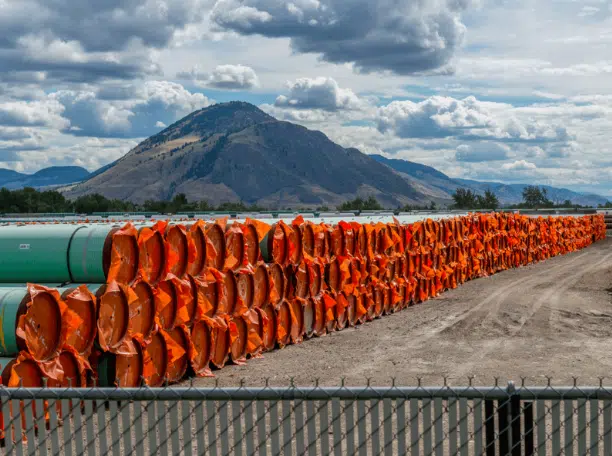
The Supreme Court of Canada has ruled today that it will not hear a new appeal of the Trans Mountain pipeline expansion project.
Four First Nations in B.C. have been battling the pipeline for years, including the Coldwater Indian Band near Merritt. Other bands involved include Squamish Nation, the Tsleil-Waututh Nation near North Vancouver and seven Ts’elxweyeqw Tribes near Chilliwack.
Those bands have challenged the legitimacy of consultations that Trans Mountain has had. Their case was dismissed in February, and the bands involved stated at the time they would be seeking a leave of appeal to have the court case continue, which has been dismissed as of today.
The Supreme Court did not explain why it won’t hear the latest court appeal.
Coldwater Indian Band chief Lee Spahan says today’s ruling is disappointing but not surprising.
“We knew the chances of the SCC granting leave were slim, given the momentum of the project and the Federal court’s finding that protection of our water can still take place in future routing decision, but we felt we had to use every tool available to us.”
Spahan has been calling for the pipeline route to be changed through his band, saying an oil spill could compromise the band’s aquifer and contaminate drinking water for the 320 residents.
He says the battle is not over to try and have Trans Mountain change its route, saying the band could formally object the pipeline route to the Canada Energy Regulator, formerly known as the National Energy Board, and he says Trans Mountain would then have to prove the route is safe.
Meantime, Trans Mountain president Ian Anderson says in a brief statement the corporation is pleased with today’s ruling from the Supreme Court.
“Following the federal government’s second approval of the Trans Mountain expansion project and many years of consultation and regulatory reviews, we are pleased to continue building this nationally important project.”
The project will triple capacity to move bitumen from northern Alberta to Burnaby. Construction of the pipeline has now already at Trans Mountain’s terminal in the Lower Mainland and through Alberta.
It’s expected to finished in late 2022, at a cost of $12.6 billion.