




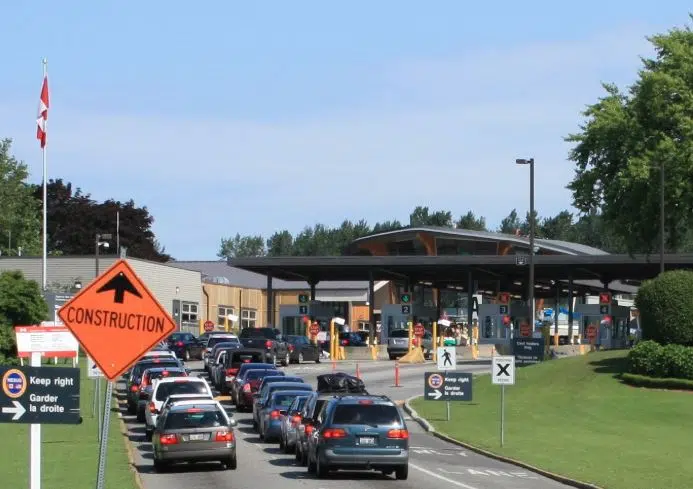
Nearly 18 months after the Canadian border was closed to non-essential travellers, the federal government will begin letting fully vaccinated U.S. citizens and permanent residents into Canada on Aug. 9, and the rest of the world about a month later on Sept. 7.
Officials say the 14-day quarantine requirement will be waived as of Aug. 9 for eligible travellers currently living in the United States, if they have received a full course of a COVID-19 vaccine approved for use in Canada – Pfizer/BioNTech, Moderna, AstraZeneca, and Johnson & Johnson.
Further, unvaccinated children under 12 who are accompanied by fully vaccinated family members will also be exempt from the 14-day quarantine though they will have to follow relevant public health guidelines in the region they’re visiting. They will also have to wear a mask in public places and avoid indoor group settings.
“The data that we’re basing the decision on today is really about a growing sense of the protection of vaccination both for infection and for onward transmission…nearly 80 per cent of eligible people in Canada have received at least one shot of a COVID-19 vaccine and over 50 per cent are fully vaccinated,” Health Minister Patty Hajdu said.
All travellers will still be required to submit a negative COVID-19 test result and proof of vaccination prior to arrival by way of the ArriveCAN smartphone app or web portal, but post-travel test results will no longer be necessary.
Canada Border Services Agency officials will also be conducting random mandatory molecular tests on people arriving in Canada.
Further, as of Aug. 9, airports in Halifax, Quebec City, Ottawa, Winnipeg and Edmonton will also be added to the list of Canadian cities where international flights are permitted to land. Currently, international flights can only land in Vancouver, Calgary, Toronto, and Montreal.
Amidst the announcement today, Transport Minister Omar Alghabra also announced the ban on all commercial and private flights from India – that has been in place since April 22 – will be extended to at least Aug. 21 because of the reported high rates of the Delta variant.
The announcement comes amidst pressure from the business community and lawmakers on either side of the border who argue that the prolonged closures will have long-term devastating impacts on local economies.
Public Safety Minister Bill Blair told reporters today that there’s no reciprocal agreement for Canadians who want to head to the U.S. for non-essential reasons like travel.
“I’m confident that as the situation continues to improve in their country that they we’ll be able to maintain a reasonable balance between the measures, but we’re doing what’s right for Canadians and we’re doing it based on the advice that we’re receiving from Canadian medical advisers,” Blair said.
The White House meanwhile declined to commit to reopening its northern border to Canadians this morning.
“We are continuing to review our travel restrictions and any decisions about reopening travel will by guided by our public health and medical experts,” White House press secretary Jen Psaki told reporters.
“We take this incredibly seriously, but we look and are guided by our own medical experts. I wouldn’t look at it through a reciprocal intention.”
Non-essential travel into Canada has been banned since March 2020, something the Canadian government said was necessary to mitigate the spread of COVID-19.
– With files from The Canadian Press