



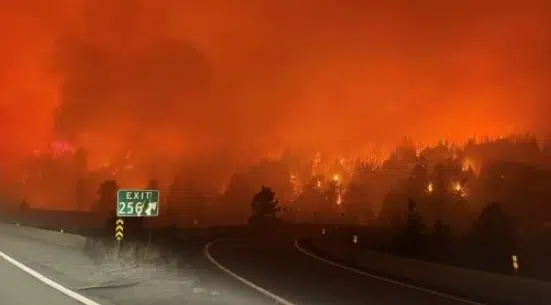
The July Mountain wildfire burning next to the Coquihalla Highway, south of Merritt, on Aug 15, 2021. (Photo: Twitter: TranBC)
A woman evacuated by the Sparks Lake fire near Kamloops this summer is asking the B.C. government to make changes to fire management.
Wendy McLean was evacuated from her home in the Deadman Valley on June 30, when the fire was burning with temperatures outside close to 48 degrees Celsius.
Among her concerns were that climate change may lead to fire seasons that overwhelm suppression agencies.
Barriere mayor Ward Stamer brought up McLean’s letter to the Thompson-Nicola Regional District board, which sparked a 15-minute discussion at today’s board meeting.
Stamer says he expects the B.C. government will table a report on the 2021 fire season, but he wants change in motion before then.
“I don’t necessarily want to wait for a task force or report from the B.C. government to identify some of the shortfalls in not only what we did when we had a fire but how we responded and after the fact. I’m not trying to point fingers, I’m just trying to say there’s a lot of things that could be changed, a lot of recommendations that have not been followed in both those 2003 and 2017 (reports),” he says, referencing the Filbin report and the Abbott-Chapman report.
“We’ve got a lot of local examples of what they have in their planning systems is not working. Period. End stop. and put 2021 or 2022 on it, and nothing’s going to change.”
Ashcroft mayor Barbara Roden says she wants to see a debriefing from the TNRD, to help educate people on who does what in a wildfire response
“One of the things I saw a lot was the lack of knowledge of residents as to who does what at every level. And where they fit, because you have people who are First Nations, people who are electoral area residents, people who are municipal residents,” Roden says.
“And I think a lot of the frustration in Lytton is coming from the fact that you have all three of those levels involved, and people see friends and neighbours getting back on properties and they’re wondering why they can’t. Saying ‘why can’t I go back onto my property when people a mile down the road are getting back onto theirs.'”
Most residents of Lytton remain evacuated after the Lytton Creek fire sparked on June 30 and destroyed 90 per cent of the village, while also killing two people. At one point in the summer, about 15 per cent of all land within TNRD boundaries was on evacuation order or alert, affecting thousands of properties.
TNRD board members floated the idea of a debriefing or creating a wildfire response task force, but no formal decision has been made on how to proceed.
Meanwhile, there has been no mention so far by the B.C. government of any report to come that will debrief this past fire season or recommend changes going forward. Last month, speaking in Logan Lake, Premier John Horgan did promise that wildfire preparation will be a “key focus” in next year’s provincial budget.