



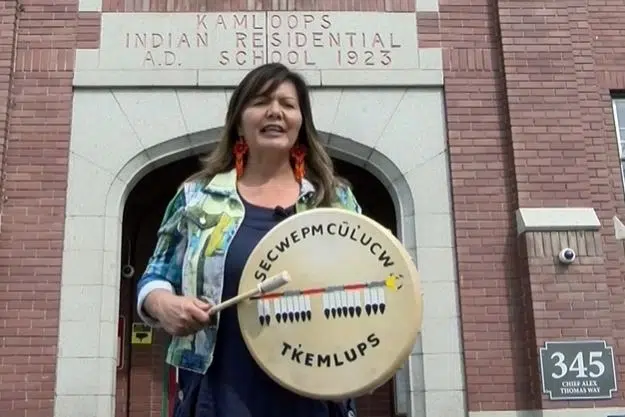
Tk'emlúps Kukpi7 Rosanne Casimir outside the Kamloops Indian Residential School building/via Tk'emlups
On the eve of the first National Day for Truth and Reconciliation, the Chief of Tk’emlúps te Secwepemc is urging people to honour the victims and survivors of Residential Schools, as well as their families and communities.
Kukpi7 Rosanne Casimir says there has been an outpouring of support since the discovery of what’s believed to 215 unmarked graves at the former Kamloops Indian Residential School at the end of May.
“It brought all of us as a community and as a nation together in a good way and for the first time, so many of our people are sharing statements like ‘they are actually listening to me’ and ‘they actually want to know’,” Casimir said.
“The awakening of many of our children being found in these unmarked graves impacted everyone nationally and globally.”
Two weeks ago Casimir put out the call to people around the world to learn the Secwepemc Honour Song so they can drum simultaneously at 2:15 p.m. Thursday afternoon.
“Our children brought us together so let us all be the ones to make the world a better place for all our children and give them the hope that today and tomorrow we continue to walk in solidarity as every child does matter,” she added. “We must define reconciliation and want to reconcile the past to give our future generations a path forward.”
“I am so thankful for the inner strength and the fortitude that I have witnessed Indigenous people draw upon and continue forward despite the current and historic impacts. We are united for all our children.”
The City of Kamloops is also encouraging all staff and residents to recognize the first National Day for Truth and Reconciliation on Sept. 30
“We are proud as a city to support National Truth and Reconciliation Day,” Mayor Ken Christian added, noting the City continues to work with TteS and other community partners to advance reconciliation locally in Kamloops.
“The finding of the missing unmarked graves at residential schools, first in Kamloops and now across the country, has raised awareness about the truth of residential schools. It is more important than ever to ensure that education and awareness continues and that we honour residential school survivors and the children who did not go home.”
Support services for residential school survivors in British Columbia:
* The KUU-US Crisis Line Society provides a 24-hour, provincewide Indigenous crisis line for Indigenous peoples in B.C. Adults, call 250-723-4050. Children and youth, call 250-723-2040. Toll-free: 1 800-588-8717
* First Nations and Inuit Hope for Wellness Help Line for Indigenous people across Canada toll-free 1-855-242-3310 or chat online: https://www.hopeforwellness.ca/
* The Métis Crisis Line for Métis people in B.C., available 24 hours a day at 1 833 MétisBC: 1-833-638-4722
* Tsow Tun Le Lum for Indigenous peoples in B.C., phone: 1 888-403-3123
* Indian Residential School Survivors Society, phone: 1-800-721-0066 or 604-985-4464
* 24-Hour National Crisis Line for residential school survivors and others affected: 1-866-925-4419