




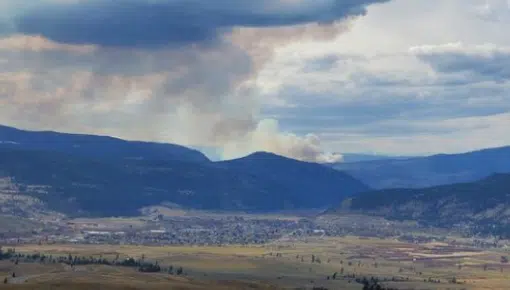
The mayor of Merritt says there were many complications with trying to support a huge number of wildfire evacuees this summer.
Speaking during a Thompson-Nicola Regional District committee meeting, Linda Brown says evacuees came from Lytton (many of whom are still evacuated in the city), and in weeks that followed people had to flee from Logan Lake, Lower Nicola, the Lower Nicola Indian Band, Spences Bridge and many other nearby communities.
The entire City of Merritt was also on an evacuation alert of its own at one point in August.
“Everyone was coming to Merritt, but Merritt was closed. And it wasn’t anybody’s fault, it just happened that way. We didn’t have the resources to take them. Even they were talking about asking us to open up our parks to have them take RVs into the parks. We had no restaurants for them. We had no resources. We had no water available for them and no washrooms around. It was just an absolute disaster.”
Speaking about how to address some of the shortfalls for future wildfire years, Brown says the Emergency Social Services payment system needs to be changed to make it less a strain for businesses that take part.
“We had one restaurant in the City of Merritt willing to participate in this process, because it was such a long, arduous task for them, that they couldn’t have the extra workload. One restaurant only, for Lytton, Logan Lake, Lower Nicola, and the Lower Nicola Indian Band. We had one restaurant trying to support them.”
Brown says there was also a miscommunication with evacuating people from nearby.
“When Kane Valley was on fire, the RCMP in Merritt was sent out to three or four homes. There were two campgrounds there that nobody told them about that were filled with tourists. And there was about 90 people there and they had to evacuate. They were missed, completely, by everyone.”
The wildfire situation was so dire that many evacuees ended up having to sleep in their vehicles.
When Logan Lake was evacuated, a notice was sent telling residents to “prepare to sleep in their vehicles” if needed, based on a shortage of lodging across the province. A spokesperson with Emergency Management BC said that the organization had asked Logan Lake to change that messaging.
EMBC senior regional manager Andrew Morrison addressed some of the unique challenges that arose this past summer, while speaking at the same TNRD committee meeting.
“Our normal ESS is, go to the nearest community. Go to a host community… All of the City of Merritt and even the City of Kamloops were under alert at some point. The City of Vernon too. All of our major centres that we would traditionally use for mass evacuations or any evacuations, where those services and supports are available, were not available on game day.”
Morrison also says there were many highway closures that made travel difficult, and he says Highways 1, 3 and 5 were all closed at one point in August.
“There were some significant challenges. Over the course of the summer, everything from evacuation orders that were directing people to communities that did not have an active reception centre, to people being told to sleep in their cars. That happened,” he says.
EMBC also was hesitant to arrange group lodging in facilities, like what was done in 2017, because of the COVID-19 pandemic.