



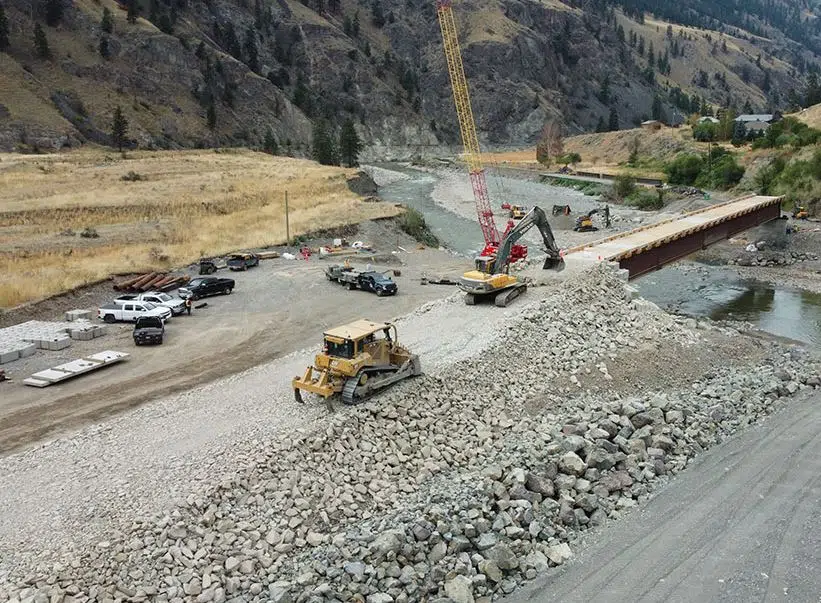
Temporary repair work underway on the Highway 8 corridor in August 2022. (Photo via Tran BC)
Communities that rely on the Highway 8 corridor between Merritt and Spences Bridge say the reopening of the highway to all traffic is a significant event.
Speaking on the NL Morning News, Merritt Mayor, Mike Goetz, said it another step in the journey to getting back to some kind of normalcy.
“It may not seem like a lot to some people but that road does connect with a lot of our neighbours, our First Nations neighbours, our friends and neighbours that are in Ashcroft, Cache Creek or down the Fraser Canyon. It is nice to have that returned to us because we sure missed it,” he said.
Echoing a similar sentiment made by Transportation Minister, Rob Fleming, Goetz says he is also grateful to all the people who worked on getting Highway 8 back open.
“I know it was a Herculean effort for the people that worked on it,” he said. “We had a rock quarry in town here and we had trucks going by 24/7 for what seemed like eight months, and I know there was a lot of collaboration between the government, the First Nations, and Merritt.”
He is also reminding drivers on that highway to be careful as it is still an active construction zone, with crews turning their attention to more permanent repairs.
“This will not be an artery if we do lose the Coquihalla or something like that. This would not be considered a main artery for traffic that has been taken of the Coquihalla, so not it won’t be used for that because it is just not ready yet,” Goetz said.
It is not just the City of Merritt, the First Nations communities along the Highway 8 corridor are also celebrating the reopening of the highway.
Cook’s Ferry Indian Band Chief Christine Minnabarriet says that stretch of highway has “significant value” to her community, as it connects her people to other First Nations as well as to the City of Merritt.
“Highway 8 is more than a road to us. It is connection, it is spirit, it is a main artery within our nation,” she said during the Wednesday news conference.
“We are happy to have that corridor open to connect families and bring them home. It has significant value to our nation. It provides connection to each other, our resources, hunting, fishing, gathering, even spiritual. But also to health care and other emergency services.”
Also present on Wednesday were representatives from Nicomen, Nooaitch, and Shakan who touted the importance of the highway and working together on the repair efforts.
Nicomen Indian Band Chief, Norman Drynock, said community members are still scattered as the one-year anniversary of the flood approaches.
“When I came up this way, I had my heart squeezed because there are homes gone. I used to honk the horn to a real close friend of mine, but his home is not there,” Drynock said.
He also noted that without that highway, the cost of fuel for his community cost “four times everybody else’s” as it had to be shipped in from a greater distance. Like Chief Minnabarriet, he says Nicomen community members have better access to things like healthcare, now that the highway is back open.
The Shackan Indian Band was one of the hardest hit, with Chief Arnold Lampreau, saying the flood impacted every aspect of day-to-day life.
“When you look at the countryside, and how it’s been devastated, our animals are not there, our sustenance is not there,” he said.
Fleming said about 30 per cent of the workers who rebuilt the highway were Indigenous, noting they provided not just the labour, but also expertise in building back better around the Nicola River.
“[We were] working closely and collaboratively with First Nations who have a long oral history and millennia of knowledge around the Nicola River, around the health and wellbeing of fish populations, around where the river has historically been and where its trying to get to,” he said. “It predates any of us and certainly predates the department of highways and public works, as it was called in the 1890’s.”
“It was very helpful to plan the right kind of habitat restoration, to also look at strategies around armouring embankments and where areas of vulnerability are based on literally centuries of living along that corridor.”
Marcel Shackelly, the chief of the Nooaitch Indian Band, also noted the collaboration between First Nations and Fleming’s ministry.
“On all the work that happened on Highway 8, it feels like we’ve made many leaps ahead in understanding how to work with each other. So that if we keep on this path, supporting the principles of UNDRIP that we will find a path forward,” he said.
Minnabarriet added that her community is eager and willing to partner with the provincial government on permanent repairs, while also inviting the Minster back to celebrate the completion of those permanent repairs in the future, whenever that may be.
“Cook’s Ferry still has four homes that have not been able to come back,” she said. “When we bring them home, they’re seeing change, just as you will when you go down Highway 8. That hits home. It takes more than one ministry to help recover from that, but all in all, Kukstemc.”
“I’m happy to have the road open today.”